Showing posts with label spelling. Show all posts

October 19, 2016

Halloween Word Play - Seek & Spell Fun!

How much time do you spend each week on spelling instruction? If you’re an upper elementary teacher, the answer is probably “not enough.” While you might recognize the importance of phonemic awareness and phonics lessons, there’s just not enough time for true spelling instruction in the upper grades. This is unfortunate because upper elementary students still need lots of practice with spelling word patterns and the basic building blocks of large words, like roots, prefixes, and suffixes.

Fortunately, there’s a fun activity for building spelling skills that your kids will love so much they won’t even realize it's a spelling assignment! In fact, they will BEG to play it!

Remember the word game where players try to make small words from the letters of a long word? It’s really simple, and most people can easily find a handful of words with very little effort. But in order to find a lot of words, you have to dig deeper and look for word patterns, word families, root words, verb forms, prefixes, suffixes, and so on. The more you play the game, the better you become at identifying these basic building blocks of language.

A few years ago I introduced this word game to my class as a fun holiday-themed activity. I created seasonal printables similar to the Halloween Seek & Spell freebie shown above, and each printable had the letters of a seasonal word or phrase printed in block letters along the bottom edge of the page. The directions required the students to cut out the letters and physically move them around to try to form new words. Students worked for about 10 minutes on their own, and then I asked them to pair up with a partner to check each other’s spelling and look for more words. Just for fun, I added a scoring system where students could earn points for correctly-spelled words. To prevent guessing, I also deducted points for words that were misspelled. Because I knew they would be able to find far more words than they could spell correctly, I encouraged them to use a spell-checker or dictionary look up any word they weren’t sure how to spell.


October 31, 2015

Seek & Spell Challenge - Word Work That WORKS!

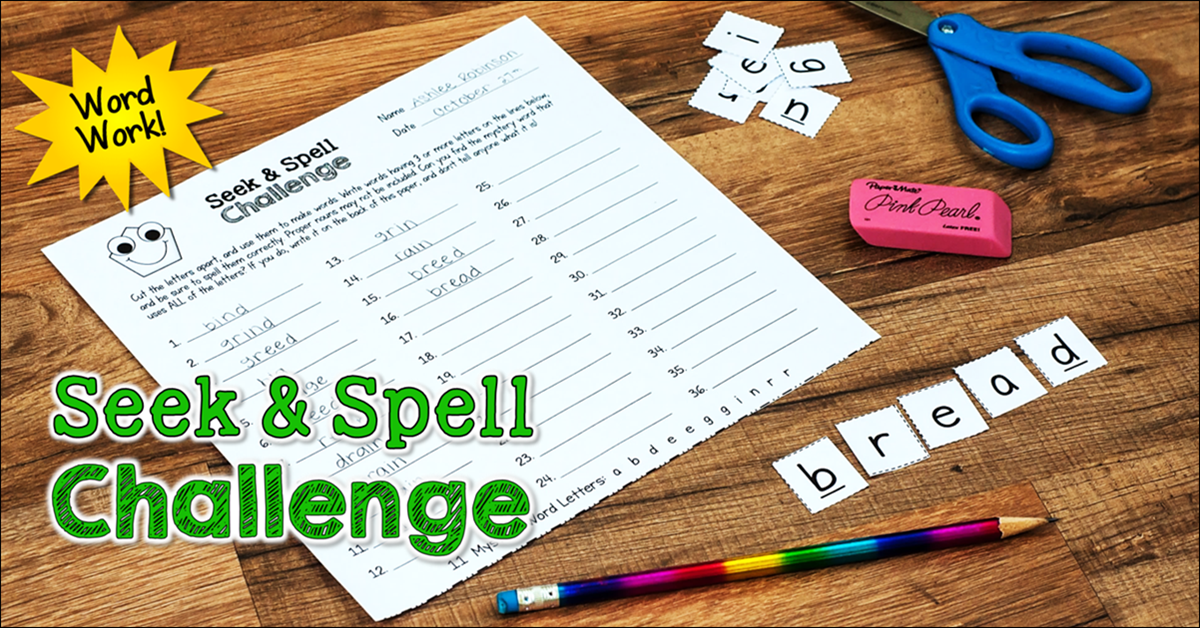
Seek & Spell Challenge is an engaging word work activity that's so fun your kids won't know they're learning!
Do your students groan when it's time for spelling? Spelling might be an important subject, but it doesn't exactly inspire a passion for learning! But that might change if you introduce your kids to Seek & Spell Challenge! In fact, they might BEG for this activity!

Students are given a set of letter tiles that they use to create and record as many words as possible. Making words with letter tiles is not a unique concept, but Seek & Spell Challenge has a unique twist that makes it motivating and fun for kids. What's the secret sauce? Simply that all of the letters can be unscrambled to form a "mystery word," and kids love the challenge of searching for that word!

I first created Seek & Spell Challenge as a fun seatwork activity for my 5th graders to be used on special days, like the the morning of a field trip or the day before a holiday because it had a calming effect on the class and my students enjoyed it. But when I noticed how much my students' spelling and foundational reading skills were improving, I started including it as a regular work work activity in my literacy centers. The results were even more amazing when I used it weekly!

When I began creating my monthly  Seasonal Activities Mini Packs, I included a similar word work activity in some of the packs. The only difference was that kids didn't have to look for a mystery word, because the word or phrase was written at the bottom of the printable. (This Words in a Word example is in my November Activities pack.)

But about a month ago, I came across one of my old mystery word printables, and I realized that the original activity was worthy of being a separate product. Furthermore, it was so motivating and effective that it NEEDED to be shared with other teachers!

I decided to run the Seek & Spell Challenge concept by the elementary teachers in one of my Facebook groups to see what they thought about it. They loved the idea!  So I invited those who were interested to work with me on the project. I had only used the activity with 5th graders, and I wanted to adapt it for younger students and test the activities in classrooms from 2nd grade to 5th grade.

As I created the mini-lessons and printables and shared them with the teachers, they offered great suggestions, like using lowercase letters instead of the uppercase letters I had been using. The 2nd grade teachers asked for a variation of the printable with fewer lines and larger spaces for recording words. Throughout the process, these amazing teachers tested the printables and activities in their classrooms. Everything worked perfectly as planned!

Seek & Spell Challenge is an engaging word work activity that's so fun your kids won't know they're learning!
Click HERE to download a PDF preview.

What Teachers Love About Seek & Spell Challenge

I loved seeing the photos of students working with the materials, but the best part was reading feedback from the teachers about why they love the program. It was so validating to learn that what I had experienced in my classroom was happening in other classrooms, too. Here's what a few of teachers shared with me:
Seek & Spell Challenge engaged my students and encouraged "real thinking" about words and their spelling. I loved watching teams of two work together and brainstorm and then check the word wall or their "quick words" for correct spelling. Having to find the "Mystery Word" was the bonus! The kids loved this concept and it provided a nice challenge for those who needed it. Manipulating the letters is important for student growth as it provides practice and exposure that they need as spellers, writers, and readers. ~ Cheryl Jordan, 2nd  Grade
 My students loved Seek & Spell Challenge! I had them work individually and then with a partner. They enjoyed comparing the words they each had made, finding those that were the same and those that were different. They saw that they could rearrange the letters in each other's "big" words and make smaller words too. I know there are similar word work activities; however, this packet is much more thoroughly put together and easier to prepare and use in the classroom. ~ Cheryl Barrios, 3rd and 4th Grade
I love how Seek & Spell Challenge is naturally differentiated for each student’s level; my lowest students could find success and my higher students could find challenges. ~ Deena Hayes, 5th Grade
My students loved the kinesthetic aspect of Seek & Spell Challenge. It was interesting to watch how they created words and how the activity easily differentiates itself as the kids are working. Having the letters that can be confused underlined helps greatly. Even though my kids needed help finding the mystery word, they were still so excited to get to it via my clues and were just as happy when they finally figured it out. The mystery part adds such a fun element to the whole activity. ~ Sally Campbell, 2nd and 3rd Grade

Seek & Spell Challenge Holiday Word Work Freebie

Does Seek & Spell Challenge sound like an activity that would benefit your students? Wouldn't it be nice if you could try it before you buy it? :-) You can!

To give teachers a chance to test out the activity, I created a holiday word work freebie that's similar to the sets of mystery word printables in Seek & Spell Challenge. The reason I titled it a holiday activity is that the mystery word is "gingerbread," but you can use this one any time of the year. There's no holiday clipart on the page itself.

Download this word work freebie from my TpT store and try it with your students to see how it works. Here are some features you'll love about the Seek & Spell Challenge program:
  • Ready-to-use, no prep printables
  • 36 mystery words (1 per week)
  • Several options for grading rubrics
  • Editable printables and rubrics
  • Several formats make it easy to differentiate
  • Hands-on, kinesthetic approach    

Thanks to My Teacher Field Testers!

I wanted to wrap up with a funny story from Deena Hayes who tested the activity with her 5th graders. Sometimes teachers have to be a little sneaky to get kids started on a new activity, and Deena knew just what to say at the first sign of resistance!
"My class had a great time completing the activity. At first, they weren't exactly thrilled, because it looked like a spelling activity. I reassured them that it wasn't spelling at all, instead it was a fun puzzle contest. With that, the race was off and running!"
I am so grateful for the help from my field testers; Seek & Spell Challenge would not be the awesome resource that it is without their feedback and suggestions! To show my appreciation, I listed them all in the acknowledgements at the end of the book... and I sent them all a free copy of the finished product, of course!


September 22, 2015

Spelling Stories - Creativity Unleashed!

Tips for assigning spelling stories ... great way to unleash your students' creativity!
Have you ever asked your students to write a story with their spelling words? It may not seem like the most original assignment, but the resulting stories are always tremendously creative!

This assignment may not sound exciting, but it's an extremely effective way of assessing how well your students understand their spelling words... and the stories are fun to read! If you don't believe me, just read the spelling story below that was written by Derrick, one of my former students!

Here are some practical tips to help you unleash your students' creative talents with spelling stories.

Tips for Assigning Spelling Stories
For several weeks before you ask your students to write stories with their spelling words, have them write spelling sentences. For that assignment, I allowed them to choose 10 of their spelling words and to write a complete sentence that showed the meaning of each word. It was only after they mastered that assignment that moved on to spelling story assignments. Here are the basic directions I gave my students; feel free to modify them according to your students's needs. I allowed them to change the form of the word slightly, such as making it plural, changing the verb tense, and so on.
Use at least 10 of your spelling words in a short creative story. The story can be silly, but it must make sense and must be more than a collection of unrelated sentences. Underline all spelling words used in the story. You may use other forms your spelling words, but be sure to spell them and use them correctly.    
Creativity Unleashed
Sample spelling story in blog post by Laura Candler with tips about assigning and scoring spelling stories.Most spelling lists include unrelated words, so students must be very creative in order to include at least 10 of them. I don't mind if the stories are short as long as they meet the requirements. Sometimes the funniest and most creative stories are the shortest ones! I'll bet you have at least one student who likes to take shortcuts on assignments. If your students are like mine, they will write the most hilarious stories just to get the assignment done with the fewest words possible! Click the story on the right to read Derrick's story, a perfect example of creativity unleashed! He used 14 words in a story that wasn't even a full page long.

Tips for Grading Spelling Stories
Spelling stories can be tricky to grade, but if you're going to grade them, it's important for your students to understand your grading policy. Rubrics are perfect for grading these types of assignments because they keep you from being too subjective. You can download and use my Spelling Story Rubric from the Spelling page on Teaching Resources if you like it, or modify it if needed.ips for assigning spelling stories ... great way to unleash your students' creativity!
Each of the 5 criteria on the rubric can receive up to 5 points. After you assign the points and total them, you can use the scale at the bottom to convert that total to a letter grade. I suggest sharing the rubric with your students and their parents before they write their very first story. You might even want to write a sample story that contains errors and show your students how that story would be graded. Then display Derrick's story example shown above and have your students help you score it with the rubric.

Free Spelling Story Rubric included in post with tips for having students write spelling stories.

Tips for Sharing Stories
At some point during the writing process, be sure to provide an opportunity for students to share their stories with their classmates. If you have a class blog or website, post the stories online for everyone to read there. Morning meetings and author sharing times are great opportunities for sharing, too. Our favorite time to listen to spelling stories was Friday afternoon when everyone was packed up and we were waiting for the final bell to ring. I would call on volunteers, one at a time, to sit on my teacher stool and share their spelling stories. It was a fun way to wrap up the week and always left us laughing as we walked out the door!


February 15, 2013

Spelling Story Tips

Oops! Looks like you followed an old Pinterest pin or an old link to this page. The blog article you're looking for has been updated, and it has moved to a new page. Click over to Spelling Stories - Creativity Unleashed to find those tips and freebies. Sorry for the inconvenience!