November 16, 2012

Literature Circles Made Easy - New Resources


New Book Recommendations and More!

The weeks between Thanksgiving and Christmas can be a challenge for you and your students. Everyone is excited about the upcoming winter holidays, and it’s hard to keep kids focused on their work. This is especially true in reading, because when students are reading or working quietly on assignments, their minds can easily wander. Literature Circles to the rescue! This instructional strategy is fun, engaging, and effective, and now is the perfect time to get started!

If you've never tried Literature Circles, you might be wondering what this strategy is all about. Literature Circles are often called Book Clubs, and they operate much like adult book clubs. In a nutshell, students form groups by selecting books that interest them. Then they meet regularly with other students who are reading the same book to discuss what they’re reading. If Literature Circles sound a bit overwhelming, don’t worry! I’ve compiled an entire collection of resources on my website, including some wonderful new book recommendations, to make them extremely easy to implement.

Literature Circles Freebies on Teaching Resources 
About 15 years ago when I first started my Teaching Resources website, I created a page to gather and share free Literature Circle resources. I eventually added so much content that I had to divide it into several different pages by category. You’ll find descriptions of different Literature Circle strategies, a free webinar recording in which I explain how to implement Literature Circles, and tips for managing Literature Circles in your classroom. Best of all, you'll find page after page of free printables including graphic organizers, organizational tools, and other resources to help you get started. After you finish reading this blog post to learn about my other resources on this topic, you’ll definitely want to visit the main Literature Circles page on Teaching Resources.

Classroom Book Clubs
Teachers used to assign roles in Literature Circles, but that’s no longer the norm. I experimented with Literature Circles for many years and eventually developed an effective and fun method that does not use roles. This method worked so well for me that I created a slidecast eLearning course to share my strategies with others. Classroom Book Clubs: Literature Circles Made Easy consists of a series of short videos in which I share a step-by-step method for getting started with Literature Circles. This teaching resource is available on CD or as a digital download, and it includes student printables and organizational forms. If you’d like to know more, you can watch a short video on my Literature Circles page on Teaching Resources. You can also preview the complete packet of printables online.

New! Literature Circles Book Recommendations
One of the most critical elements of developing a great Literature Circles program is locating terrific books for students to read and discuss. Unfortunately, this step can be difficult and time-consuming because after you locate the books, you need to find time to preview them before sharing them with your class. Fortunately, help is on the way!

A few months ago, I embarked on a major undertaking – to create a huge collection of Literature Circle books recommended by teachers for teachers. I’m excited to announce that Favorite Literature Circles Resources is now live on my website. Here you can find book recommendations for professional reading as well as four pages of book recommendations for students in one convenient location. The student books are categorized by genre, and you can click the book covers on those pages to read more recommendations on Amazon.com. I’m working to add links to the audio CD versions of those books so you can differentiate instruction for your struggling readers. The audio versions will also save you time because you can listen to them to preview the books before using them with your class.

Collaborate and Share
What’s your favorite book for Literature Circles? If you would like to help add to the growing collection of teacher recommendations, click this Google Doc link to share your favorite title with us. From time to time, I’ll update the pages with new book titles, and I may use your suggestions to create a downloadable list of recommendations. Click here to sign up for my free Candler's Classroom Connections newsletter to be sure you're notified of new resources on this topic.

Good luck with Literature Circles! I hope these resources help you and your students enjoy the weeks between Thanksgiving and Christmas, making this an enjoyable and stress-free time in the classroom!


November 4, 2012

Favorite Read Alouds for November


November is a great month for read-alouds! Here are a few of my favorites for Thanksgiving and Veteran's Day. These short picture books are perfect for upper elementary students and work well with many fall-related activities.

November is a great month for reading aloud! Here are a few of my favorite books for Thanksgiving and Veteran's Day. These short picture books are perfect for upper elementary students and work well with many fall-related activities. At the end of the book list, you'll find a link to my November Activities pack which includes activities for many of these titles.

If you aren't familiar with these titles and would like to read more reviews, detailed descriptions, or purchase the book, you can click on the title or cover image, and you'll go right to it on Amazon where you can get more information! I also recommend that you locate your books several weeks in advance of the lesson so you can read them and make sure they are right for your class.


Thank You, Sarah: the Woman Who Saved Thanksgiving 
By Laurie Halse Anderson and Matt Faulkner

Thank You, Sarah is a wonderful book about the history of Thanksgiving in the United States and how Sarah Hale helped make it a national holiday. It's great for teaching students about the "power of the pen" and how one person can make a difference.


If You Were At the First Thanksgiving 
By Anne Kamma

If You Were at the First Thanksgiving is a great nonfiction book organized in a question and answer format. It provides information about the first Thanksgiving as well as information about how the Pilgrims lived when they first came to America.


Oh, What a Thanksgiving!
By Steven Kroll and S. D. Schindler

Oh, What a Thanksgiving! is perfect for comparing and contrasting Thanksgiving today with the traditions observed by the Pilgrims. Children today will find that Thanksgiving long ago was much different!


'Twas the Night before Thanksgiving
By Dav Pilkey 

This hilarious book takes the form of a long, illustrated poem with a single stanza on each page. While the stanzas are similar to the traditional Christmas poem, the story is anything but traditional! Your students will love the surprise ending!


The Wall
By Eve Bunting and Ronald Himler

The Wall is an excellent book to read to students when discussing Veteran's Day. It's a touching story about a boy who travels to the Vietnam Veterans Memorial with his father to seek out his grandfather's name.


I hope you enjoy sharing these with your students as much as I do. They are a great way to foster a warm holiday spirit in the classroom. You can also find activities for many of these books in my November Activities from Teaching Resources Mini Pack.

If you have a favorite book for November, please share your suggestions in a comment on this post. Happy reading!


November 1, 2012

Thankful Writing Craftivity

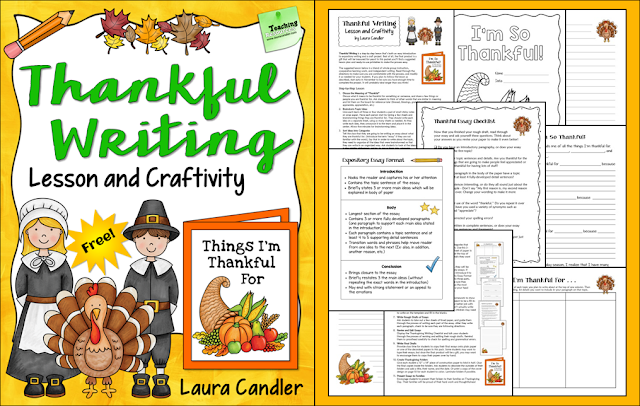
Thankful Writing is a freebie from Laura Candler that's a step-by-step writing lesson and a craftivity all in one.The final project is sent home with students to be shared with their families on Thanksgiving day, and it's sure to be a memorable keepsake!
Free Thanksgiving Writing Lesson and Craftivity!

November is finally here, and what better time to think of all of the things we are thankful for? This topic might seem may seem trite and overdone for a writing assignment, but we can never overdo the message of learning to show appreciation for the people and things that make our lives rich and fulfilling.

Fortunately, this topic also makes a great first expository essay for upper elementary students because it's so easy to organize and write. Yes, it does involve "formula" writing, but I believe in starting out with one formulaic essay to teach students an easy way to organize their thoughts into a coherent paper. I loved having my students write about the people and things they were thankful for because it helped them focus on the positives in their lives, and their final essays made a nice gift to their families on Thanksgiving Day.

Thankful Writing is a freebie from Laura Candler that's a step-by-step writing lesson and a craftivity all in one.The final project is sent home with students to be shared with their families on Thanksgiving day, and it's sure to be a memorable keepsake!The final step of the activity is what makes this project really special. After student write the final drafts of their papers, they staple them into a folder made from a large sheet of colored construction paper. Each student decorates a cover and glues it on to the front of his or her folder to create a special keepsake. If you really want to turn this activity into a full fledged "craftivity," provide plenty of time and lots of creative materials for students to use when decorating their Thanksgiving folders to take home.  Having students add a small photo and the date is a nice touch because many families will treasure this special gift and keep it for many years.

Thankful Writing Craftivity Freebie

My "Thankful Writing" activity became a yearly tradition because it was such a terrific writing activity, and it was so appreciated by my students' families. Because it worked so well for me, I wrote up the complete directions to share with others as a freebie. It's my little gift and my way of showing my appreciation for the many educators who have shared so much with me through the years. The packet includes complete directions, a graphic organizer for brainstorming, and directions for introducing students to expository writing. You can download it from my Seasonal Page on Teaching Resources during November, and my newsletter subscribers can find it on Laura's Best Freebies page any time of the year.

Thankful Writing is a freebie from Laura Candler that's a step-by-step writing lesson and a craftivity all in one.The final project is sent home with students to be shared with their families on Thanksgiving day, and it's sure to be a memorable keepsake!

Tips for Success

Here are a few things to keep in mind that will help make this activity a success.
  • Timing - If possible, start on this activity several weeks before Thanksgiving, especially if your students have not written an essay before. You'll be surprised at how much time it takes to brainstorm ideas, teach them the format, write the first draft, revise and edit it, and create the final draft. You should also allow plenty of time for students to decorate their covers. 
  • Grading - If you are spend spend several weeks on this activity, you'll probably need to assign some sort of grade to it. You could do a participation grade based on overall effort and quality of work. If you need to write comments on their work to justify your grade, you won't want to write in the copy that students are going to give to their parents. What I did was to make a copy of the essay for myself so that I could write comments on it. I felt that since this was their first expository essay, it was more of a learning activity than an assessment so I tended to grade it very leniently. Most of my comments and feedback took place during the writing conference so my final grade ended up being more of a participation grade than anything else.
  • More Cover Options - I recently revised and updated this freebie, and it now includes a coloring page that you can print for students who might obsess over decorating their covers. However, I think most parents would rather see original artwork on the cover. One option might be to have the create the traditional hand-tracing turkey as the cover art. Check out this version that I found on Enchanted Learning for a slightly different approach. 
The day before Thanksgiving, provide time for students to share their final writing projects with their classmates before they bring them home to present to their families. You'll find this to be a nice way to end the day before you send them off for the holidays!


October 30, 2012

Spontaneity Brings Math to Life!

By Nyla Phillips-Martin, Guest Blogger

Last week, while in the midst of teaching a lesson on cuboids, I quickly realised that I had to do something drastic to get the attention of my most easily distracted student. I mean, there I was feeling all proud of myself for having everything I needed, I had my examples and non-examples for the students to handle, observe and compare attributes. My classroom was buzzing with excitement; hands were fervently flying up during Q & A time as I selected students to answer questions.

But the hand that I was looking for at the front corner of the class never went up. Justin (let’s call him Justin) just sat there looking away from me, tapping his ruler on the desk. Then he poked another student with his pencil. Now, it is not uncommon for him to be like this because he sometimes gets into trouble in order to avoid class work. What I needed to do was to get his attention without halting the momentum that the other students were having. At that moment, an idea popped into my head.

I walked out of the room, spun around and returned with a silly grin and a cuboid net in my hand. I didn't say a word. I just slowly folded the net into a talking cuboid (like a puppet). Think of a box with the top lid open – that flap became the puppet’s mouth. Anyway, I used the silliest voice I could muster and made the puppet talk.

He introduced himself as Corey the Cuboid and went on to talk about his other siblings and the fact that he feels like the odd one out because he cannot roll like the cylinder or sphere and he’s not as cute as his brother the cube. My fourth grade students were wide eyed and everybody was paying attention – not to me the teacher, but to the cuboid on show.

They all wanted to have their turn with handling Corey the Cuboid and making him talk (including Justin). In fact, they had so much fun making him talk that I videotaped one of my students as she brought Corey to life!


I really enjoyed that cuboid net lesson and it taught me that even with a lot of planning, a touch of spontaneity keeps things interesting. The lesson gave me an idea for their math project – to have them put on their own puppet show featuring different talking 3D Shapes.

If you like the idea of having students create puppets from 3D shapes, feel free to use the patterns from this free assortment of 3D shape nets that I created to save yourself some time! And don’t forget to flip out and be just a tad spontaneous!


Nyla Phillips-Martin, is a young wife, mother, and teacher in the Caribbean. She has a B. Ed Degree in Primary Education and is in her seventh year of teaching. She hopes to show other teachers in her country the power of using technology for use in records, planning and especially in the classroom. To her, education is all about fostering creativity and facilitating hands-on learning. Visit Nyla's blog, Nyla's Crafty Teaching, for more engaging lesson ideas!

October 24, 2012

Winning a Million - Math Lessons and More!


What would you do if you won a million dollars? The NC Education Lottery offers winners a choice between the entire amount paid over 20 years, or a lump sum payout of a smaller amount. What are the implications of each choice?

Today I saw a news article about a local man, James Anderson, who won $1 million in the Holiday Millions lottery game. One part of the story in particular really captured my interest:
"Top prize winners in the Holiday Millions game have the option of claiming their prize as a 20-year annuity or a lump sum. Anderson chose the $600,000 lump sum, which left him with $408,006 after taxes."
When I read this part of the article, my teacher brain went into overdrive! Do you realize that by accepting $600,000, Mr. Anderson gave up $400,000 of his payout just so he could get the money now instead of spreading it over 20 years? Furthermore, the government took such a big chunk that he now has less than half of that million dollars.

Million Dollar Lottery Lessons
As I read this, I immediately saw all kinds of possibilities for lessons about winning a million dollars. There are loads of obvious math lesson ideas, but I can also think of many literacy lessons as well. Here are a few quick thoughts about where you could go with this topic. Please share your ideas, too!

  • Read informational text.  Begin by having students read the article. You can find the article online here on the Fayetteville Observer website.  Then ask them to complete a "What's the Scoop?" graphic organizer to uncover the important facts and details in the news story. You could also use the Current Event Report form in my Social Studies file cabinet to have students write a summary of the important information. 
  • Analyze the math involved in Mr. Anderson's decision. What exactly did it mean in financial terms to take $600,000 now instead of a million paid over 20 years? I called the lottery hotline to make sure I understood how the 20-year annuity worked, and it's basically an option for taking out 1/20th of the money each year for 20 years. So how much money did Mr. Anderson give up? If you received a million dollars in annual payments over 20 years, how much would you get each year? What would that be on a monthly basis? What is the average salary in America? Would you be rich, living comfortably, or just getting by?  
  • Debate the pros and cons of the two payout options. Even though he gave up $400,000 to take out the immediate lump sum of $600,000, it might actually not be such a bad deal if he invests the money wisely. Disregard taxes because taxes will have to be paid on the money either way, and consider what would happen if he invested the full $600,000. What interest rate would be needed to make that money grow to $1 million in 20 years? As a side note, the person I spoke with on the lottery hotline said that the last 5 jackpot winners all took the lump sum payout. I'm assuming they contacted a financial adviser before making that decision, so it may be that taking the lump sum is a better option. But what if you took the money and just spent it? Would you be able to invest it?
  • Explore probability - Discuss the probability of winning money in the Holiday Millions game. You can read more about this particular game on the Holiday Millions page of the NC Education Lottery website. Players can win different amounts; what is the probability of winning each amount? (Click here to download a chart showing the approximate odds of winning.)

    A lottery ticket costs $20. Look at the odds of winning a million dollars. What if you bought a ticket every day for a year? How much would you spend? How much would you improve your chances of winning?  
  • Research possible purchases. What can you buy with $408,000 (the amount after taxes)? Research the cost of a home in your area, the cost of a new car, a dream vacation, etc. 
  • Discuss the concept of a million. Read the book How Much is a Million or If You Made a Million written by David Schwartz and illustrated by Steven Kellogg. Use the ideas in these books as a springboard for discussing just how big a million really is. 
  • Discuss impact of winning a $1 million. How would your life change? Are people with more money happier? What problems might be caused by winning a lot of money? Would people treat you differently? (I've heard that many people who win large sums of money end up broke and unhappy in a few years. It would be interesting to research the facts on this and discuss your findings with your students.)
  • Write an expository paragraph or paper - What would you do if you won a $1 million and had a choice between taking a lump sum of $600,000 or the whole amount over 20 years? How might your life change based on your decision?
These are just a few lesson ideas that came to mind as I thought about the implications of winning $1 million dollars. How would you teach a million dollar lottery lesson? I think we can agree that this topic is a goldmine of rich learning opportunities, no pun intended!