Showing posts with label math problem solving. Show all posts

September 15, 2017

How to Turn a Word Problem into a Rich Math Task (Part Two)

How to Turn a Word Problem Into a Rich Math Task
Part Two: Crafting the Process

When students struggle in math, it's often due to their beliefs about what it takes to be successful in mathematics. They believe that some people were born with a gift for math, and anyone who wasn't born with that gift will never excel in math.

Fortunately, brain research tells us that this belief is nothing more than a myth, and it's not supported by fact. All students can experience success in math if they are taught in ways that foster the development of a mathematical mindset. This means setting high expectations for all students, engaging them in challenging and interesting math tasks, and providing the right kind of support and encouragement.

One way to foster mathematical mindsets is to replace simple word problems with "rich math tasks." Rich math tasks provide opportunities for students to work together as they explore a concept or solve a problem. In my webinar, Math Problem Solving: Mindsets Matter, I give examples of rich math tasks and share several strategies for using them with students.

If you're wondering how to get started with rich math tasks, it's easier than you might think. The first step is choosing a suitable math problem, and the second step is guiding your students through the problem-solving process. Both steps are equally important, so I've decided to tackle them in two separate blog posts.

In my first post, Part One: Crafting the Problem, I explained the difference between word problems and rich math tasks, and I shared 6 tips for creating a rich math task from a simple word problem. In this post, Part Two: Crafting the Process, I'll share strategies you can use to actively engage ALL of your students in the problem-solving experience.

September 7, 2017

How to Turn a Word Problem into a Rich Math Task (Part One)

How to Turn a Word Problem into a Rich Math Task
Part One - Crafting the Problem

Growth mindset is much more than a buzzword, and nowhere is this more apparent than in mathematics. Research findings in this field are transforming our perceptions about best practices in math instruction. As it turns out, developing a mathematical mindset is more highly correlated with future success in math than scores on standardized tests!

One way to begin fostering a math mindset in your students is to turn traditional word problems into "rich math tasks."

I tackled the topic of rich math tasks in my recent webinar, Math Problem Solving: Mindsets Matter, but I want to dig into rich math tasks a bit more here on Corkboard Connections.

Rich math tasks have two critical components, the WHAT (the problem) and the HOW (the process).

In this post, we'll take a look at how to transform a boring word problem into a rich math task. In my next post, I'll share active engagement strategies you can use to help your kids rock the problem solving process! Click here for Part Two.

How a Word Problem Differs from a Rich Math Task


Basic Word Problems
Word problems at the elementary level tend to be simple problems with a single correct answer. Children are often taught to solve them by learning to identify key words and numbers in the problem and then applying the necessary mathematical operation. For example, a basic word problem might read like this: "There are 10 apples, and it takes 2 minutes to peel each apple. How many minutes in all are needed to peel the apples?"
A typical method of solving this problem involves underlining the key words "each" and "in all" and circling the numbers 10 and 2. The key words tell students that they need to multiply the numbers to find the answer, so they multiply 10 and 2 and record the number 20 as the answer. If you ask these students to draw or model the solutions visually, they are at a loss. If you ask them to label the answer with the unit, they are as likely to write "20 apples" as they are to write "20 minutes." 

Word problems don't inspire deep thinking, analysis, or discussion because the solutions are fairly straight forward. Sure, you can encourage your students to talk with a partner about how they solved the problem, but their explanations will sound like this: "First I underlined the key words, and then I circled all the numbers. Next, I multiplied the numbers to get my answer." An explanation like that hardly qualifies as "math talk"!

Rich Math Tasks
Rich math tasks, on the other hand, are usually more open-ended and can be solved in many ways. Some math tasks are inquiry-based questions that have more than one correct answer or problems that require students to use hands-on materials to discover the solutions. Other math tasks look like regular word problems at first glance, but when you attempt to solve them, you realize there are many ways to arrive at the answer. Rich math tasks don't have key words that you can underline, and circling the numbers won't help because you might not even need all the numbers to solve the problem! These types of math tasks stimulate discussion, questioning, and critical thinking as students struggle to choose the best strategy to solve the problem.


6 Tips for Crafting an Awesome Math Task

Finding or creating the right math problem is the first step in developing a rich math task. Here are some tips that will make the process of crafting your problem much easier.

1. Start with a Visual Problem
Select a word problem that's easy to visualize, and try to solve it in several different ways. Make sure the answer can be represented visually by drawing it or by using physical models. If you realize that there's only one way to solve it or that it would be difficult to represent the solutions visually, rewrite the problem or find a new one. I'll use the Apple Peeling Word Problem above to demonstrate how to turn a simple word problem into something much more challenging and interesting.

2. Remove Key Words 
After you've selected a problem, look for key words such as, "in all," "each," "per," and "total." If possible, rewrite the problem without using the key words, making sure that the meaning doesn't change. Removing key words forces students to THINK about which operation is needed instead of just underlining words and mindlessly choosing an operation based on those words.

3. Add Extra Details and Information
Next, add details that aren't really needed to find the solution. If students have been trained to underline key words and circle numbers, these extra details will confuse them. They will have to think about the task and decide which words and numbers are actually important.

Let's use the first 3 tips to rework the Apple Peeling Word Problem and turn it into Apple Peeling Challenge #1. While the problem is still quite easy, the lack of key words and the extra numbers make it a bit more challenging. Students have to think about what is being asked and decide the best way to solve it. This is a good starter problem for introducing students to rich math tasks because it can be solved in more than one way using visual models. Students could draw circles for the apples, use round objects like pennies or bingo chips, or they could even use real apples!


Ready to take Apple Peeling Challenge #1 to another level? Applying the next 3 tips to that problem will make it even more challenging and interesting!   

4.  Personalize It and Make It Real
To make the problem more interesting, personalize it by adding a real person's name, maybe even the name of one of your students! Add enough details to make it come to life or turn it into a story. In Apple Peeling Challenge #2, including the detail that Sam is peeling the apples for a pie makes the problem more meaningful. A teacher in the Math Mindset Connections Facebook group took this problem and turned it into a story about making a pie for Thanksgiving dinner!

5. Turn It into a Multi-step Problem
Rewrite single-step word problems to ensure that multiple steps are needed to solve it. The information in the basic word problem stated that it takes 2 minutes to peel each apple. The easiest way to add another step is to replace that detail with enough information for students to calculate how long it takes to peel each apple. Each problem will be a bit different, but there's always a way to modify the problem and turn it into a multi-step math task.

6. Change the Numbers
You can often make a word problem more challenging by changing the number values. For example, instead of Sam peeling 10 apples, he might need to peel 100 apples because he's baking 10 pies for a banquet. You can also use numbers that result in fractional answers. For example, in Apple Peeling Challenge #2 above, Sam can peel 4 apples in 6 minutes so kids should be able to figure out how long it takes to peel one apple. But 6 is not divisible by 4, so the number of minutes it takes to peel one apple is not a whole number. Do you see how tweaking the numbers a little can instantly make the problem much more challenging? Now you have a problem that's perfect for a math task!

Why not try creating your own Apple Peeling Challenge? In the Math Problem Solving: Mindsets Matter Webinar, I shared 2 more apple peeling problems that are quite different from the problems in this post. I'll bet you can come up with your own apple peeling problems, too!


Where to Find Editable Word Problems for Rich Math Tasks


If you don't want to craft your own multi-step word problems, or you don't have time to hunt for them, check out my newest product, Math Mindset Challenges. It's a growing collection of editable word problems in several different formats. The problems themselves are in an editable PowerPoint document so you can change the wording and customize them if needed. All of the problems have been field-tested by upper elementary teachers, and they work well as is, but if you use a different measurement system or want to tweak the problems using the tips above, you can easily do that. If you'd like to take a closer look, head over to my TpT store and click on the preview link on the product page.


The Math Mindset Challenges product shown above is included in my Math Mindset Challenges Webinar Bundle and my Math Problem Solving Bundle. Both bundles include the Math Problem Solving: Mindsets Matter professional development webinar, too.


Next Up - Part Two: Crafting the Process

Remember that rich math tasks have two essential components, the WHAT and the HOW.  In this post, I've tackled the WHAT, the math problem itself.  However, it's not enough to create a great word problem; it's what you do with that problem that counts! Click here to read Part Two, Crafting the Process, where I dove into HOW to facilitate the problem solving experience. I shared loads of active engagement strategies that will take problem solving to a whole new level in your math classroom!


August 25, 2017

Mathematical Problem Solving: Mindsets Matter


Do you love math? Or are you convinced that the math train left the station without you long ago? No matter how you feel about it, if you're an elementary educator, you'll probably have to teach math at some point. Fortunately, growth mindset research and new findings about how the brain works are leading to some amazing insights about the best way to teach math. Furthermore, these insights are making it possible to foster a love of math in ALL students!

Last year I discovered Dr. Jo Boaler's book, Mathematical Mindsets, and I was fascinated by the research findings she shared. I also loved Dr. Boaler's strategies for using those research findings to improve math instruction. I know that problem solving is essential in mathematics, and most of the strategies I was using are supported by the new research. However, I did discover that a few of my teaching methods are not actually best practices, so I've been reworking those strategies to incorporate what I've learned.

A few years ago I presented a webinar called Math Problem Solving: Once a Day, the Easy Way, but after reading Mathematical Mindsets, I knew it was time to update that presentation with these new research-based practices. I asked Dr. Boaler for permission to include information and strategies from her book in my webinar, and she graciously agreed.

My new webinar is titled Math Problem Solving: Mindsets Matter to reflect the emphasis on growth mindset research and its implications for math instruction. To learn more, download the webinar note-taking handouts and take a look. The live webinar has ended, but you can sign up for the replay below. The replay of the August 31st webinar is free through September 10th.

Math Problem Solving - Mindsets Matter 

Best Practices in Math Instruction: Agree or Disagree? 
At the beginning of the webinar, I'll ask you to evaluate 6 commonly-held beliefs about math instruction, and then I'll share what the research tells us about them. What do you think about each statement below? Do you agree or disagree with these beliefs about math instruction?
  1. Problem solving strategies should be taught before giving students problems to solve. 
  2. Drawing solutions and counting on fingers should only be encouraged for young children and struggling students. 
  3. Students should only use calculators in math after they can perform the computations by hand.
  4. Mistakes are only beneficial when we learn from them.  
  5. Some people were born with a gift for math, and others weren’t. 
  6. The best way to meet the needs of all students is through ability grouping and differentiation. 
If you want to know what the research says about these beliefs, watch the webinar replay! I dug into the best practices related to each of those statements about math instruction.

From Word Problems to Rich Math Tasks
One research finding about how to foster a mathematical mindset is pretty clear. Instead of overloading kids with traditional "word problems," we need to engage them in more in rich math tasks. In the webinar, I went into detail about what that means, but basically a rich math task encourages students to think about math in new ways, finding multiple ways to solve problems, and to discuss their findings with others. Fortunately, it's quite easy to find rich math tasks if you know where to look, and you can also turn traditional word problems into rich math task. Check out the webinar replay for tips about how find or create rich math tasks that are appropriate for your students.


Join Me for a Math Mindsets Webinar Journey!
I'm still learning about how to foster a mathematical mindset, so I consider this webinar to be more of a journey we'll take together. You can board the Math Problem Solving: Mindsets Matter webinar train here; tickets are FREE through September 10th, so hop on and take a seat now!

I'll be your conductor if you decide to take this journey with me, and I'll share what I've learned about growth mindset and math instruction. We'll wrap up our adventure by exploring painless problem solving strategies you can implement right away that will motivate your students to love math, even if you don’t! Who knows? By the end of our journey, you might be a math lover, too!


August 31, 2016

Math Problem Solving: Knowing Where to Begin

Teaching kids to how to solve math problems is a huge challenge, but often the biggest challenge is knowing where to begin instruction. Learn where to download this free set of problem solving assessments to use in your upper elementary classroom!
Teaching kids to how to solve math problems is a huge challenge, but often the biggest challenge is knowing where to begin instruction. Without administering some type of pretest, you risk boring your students with problems that are too easy or frustrating them with problems that may seem impossible.

Before you begin, you need to have some idea of their current problem solving skills. For example:
  • How do they attack different types of problems? 
  • What strategies do they use? 
  • Are they functioning below grade level, at grade level, or above?
  • If they struggle, is it due to poor computation skills, poor reading skills, or misconceptions about basic math concepts?  
The Problem with Problem Solving Pretests
Unfortunately, most math word problem pretests don't provide enough information to help us answer those questions, let alone know where to begin instruction. Many tests are so challenging that kids who've been out of school all summer are likely to give up after making a token effort to solve the first few problems. Also, most tests use a multiple choice format which makes them easy to grade, but not so easy to interpret. Students don't have a place next to each problem to show their work, so you're left guessing as to the reason they missed each incorrect answer.


September 18, 2015

6 Reasons to Teach Calculator Skills

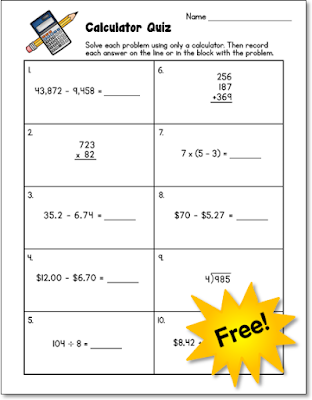
6 reasons to teach calculator skills to upper elementary students, including how calculators foster mathematical thinking. Free calculator quiz in the post!
When North Carolina first began to allow calculators on state tests, many elementary teachers (including me) were shocked! What? Kids need to develop basic computation skills before they are allowed to use calculators!

Then we got a look at the new state math test. Holy moly! The test was divided into two parts, a calculator-inactive section, and much longer calculator-active part that was made up entirely of word problems! I realized that if my 5th graders had to work out every answer by hand, they would never finish the test! I also realized that it wouldn't be fair to hand out calculators for the first time on test day. In short, I needed a new game plan.... one that involved calculators.

Calculators Are Not Magic - You Still Have to Think!
Most students are intimidated by word problems, so when I decided to introduce calculators, I felt that our problem-solving lessons would be a good place to begin. When I first handed out the calculators, my students were so excited! They seemed to think those calculators were going to magically solve the problems for them! It didn't take long before my students realized that calculators are not magic at all! Why?
  1. You still have to read the problem, choose a strategy, decide which operation to use, record the answer, and check the solution using a different strategy. In other words, you still had to THINK!
  2. Calculators aren't helpful with some types math problems, so you needed to know WHEN to use it and when it might be a waste of time.
  3. You have to know HOW to use the calculator in order to get the correct answer. The data from the problem must be entered in a specific way, and if you enter it incorrectly, you'll get the wrong answer every time. 
  4. You have to know how to interpret the number that appears in the display window when you finish entering the data, especially in problems involved time, measurement, and money.  
Why and How to Assess Calculator Skills
Do your students know how to use a calculator? You won't know for sure unless you assess those skills! Download this freebie to use in your classroom.
After they got over the disappointing realization that calculators are not magic, my students began to enjoy using them and looked forward to problem solving lessons.

However, I soon noticed that some students knew how to solve the math problems, but they were getting the answers wrong because they didn't know how to use their calculators properly. Time for some calculator lessons! I knew that some kids didn't need the extra help, so I created a simple 10-item Calculator Quiz to find out who did. You can download this free assessment from my Daily Math Puzzlers page. When I handed out the test, I told my students that they were not allowed to work out any problems on paper. They were required to use their calculators and they could only use their pencils to record their answers. Needless to say, they were shocked! "You mean we can't work out the problems on paper even if we WANT to?" "Nope. Sorry. Only the calculator."

After I scored the tests, I taught several guided math group lessons to the students who were having difficulties. The other students used the time to work on math center activities. Then I retested the kids who I had worked with to be sure they had mastered the basic calculator skills. These lessons were so successful that I included calculator instruction in each Daily Math Puzzler book.

6 Reasons to Teach Calculator Skills to Upper Elementary Students
So why should we teach upper elementary students how to use a calculator? Based on my own experiences and feedback from other teachers, I am convinced that calculators boost mathematical thinking and are motivating to students. Here are 6 reasons to teach calculator skills and to encourage your students to use them to solve math problems.
  1. Calculators help kids overcome computational limitations.
    Kids often have the conceptual understanding to solve problems that are much more difficult than their computational ability would allow. For example, a student might know they need to divide a 2-digit number by another 2-digit number, but if he or she hasn't mastered this skill, the answer will be out of reach without a calculator. Overcoming computational limitations is especially helpful for special needs students and actually removes barriers to more advanced levels of math instruction.   
  2. Calculators encourage the use of multiple strategies.
    Being able to use a calculator frees students to consider and test out a wide variety of problem solving strategies in a short time. They can solve a problem using one strategy (without or without a calculator), and check their answers using a different strategy. 
  3. Calculators help kids solve more problems in less time.
    Calculators allow students to work more quickly, which means they can solve more problems in a given time. So you can increase the number and complexity of the problems you introduce in each lesson without increasing the time devoted to problem solving lessons.  
  4. Calculators promote persistence in problem solving.As students begin to think more creatively and try different methods, they will experience success with some methods and failure with others. But it's HOW they feel about those "failures" that's important. I noticed my students were less discouraged when they couldn't solve problems quickly; they tried to figure out WHY their methods didn't work. Then they adjusted their thinking and tried a different strategy.     
  5. Calculators foster a growth mindset.Educators are starting to realize that praising students for correct answers is not nearly as important as recognizing their struggles along the way. When students are able to persist and try different strategies to solve challenging problems, they feel a sense of accomplishment and pride in themselves for not giving up which leads to the next benefit.  
  6. Calculators promote a positive attitude towards problem solving. As the saying goes, "Success breeds success," and that's definitely true in math. Using a calculator drastically increases the chance that a student will get the correct answer, and the subsequent feeling of accomplishment promotes a more positive attitude toward the next problem.  
What If Your Students Are Not Allowed to Use Calculators on Standardized Tests?
Is there any benefit to using calculators during the school year if your students are not allowed to use them on standardized tests?  Yes! Your students will still benefit from using them early in the year to boost their mathematical thinking, as long as you devote sufficient time to teaching and reviewing computation. As the year progresses and your students' computation skills improve, you can gradually wean them off calculators completely.

When Should Calculators Be Introduced?
I introduced calculator skills early in the year because my students were 5th graders who had developed a fairly solid understanding of numbers and what they mean. I don't advocate giving them to young children who have not had time to develop number sense, because entering numbers into a calculator won't be meaningful to them. You are the best judge of when your students are ready to begin using calculators. However, if you observe your students randomly punching numbers in as if they are hoping to stumble on the answer, it might be time to put the calculators away for a while and focus on math problem solving strategies.


Learning to use a calculator had a tremendous positive impact on my students' mathematical thinking and their willingness to tackle tough problems. Furthermore, because I still taught computation skills, I didn't see any detrimental impact on their ability to solve computation problems without a calculator. If you think about it, calculators are just another math tool. No, they won't magically solve word problems. However, the way calculators help students become better problem solvers IS almost magical!


April 4, 2015

How to Recharge Mathematical Thinking

Why do so many students struggle with math word problems? Maybe they just don't know where to begin and get overwhelmed at the thought of tackling math problems. Often students lack experience with different types of problems and the strategies for solving them, so they feel defeated and give up before they get started.

What can we do to help our students overcome their word problem phobias? One strategy that worked for me was to give my students opportunities to talk over how they planned to solve word problems before I let them pick up their pencils to work on them. Not just once or twice, but over and over until they were able to build confidence as problem solvers. At first, some of my students didn't participate actively in those discussions. But eventually they jumped in with their own strategies, and they were so excited when their methods worked!

If you're skeptical, you might be thinking about discussions you've observed in the past. Often one student does all the problem solving, and everyone else writes down his or her answer. But these discussions don't really qualify as cooperative learning because group members are not participating equally.

Recharge & Write for Math Problem Solving (Freebie)
To address this situation, I developed a strategy called Recharge & Write to encourage active participation and provide accountability. The basic concept is that students alternate between team discussion and independent written response. They first discuss each problem as a group, but when it's time to solve the problem and write their answers, they aren't allowed to talk. This strategy ensures that they will become active participants in the problem-solving process rather than letting others do their thinking for them. I recorded this short video to show you how it works. Click here to download the free directions and "recharger" label shown in the video.


Advanced Preparation for Recharge & Write
This strategy is easy to implement, but you'll need to do a little advanced prep the first time you use it. Recharge & Write has two important components: a "Recharger" (pencil holder) for each team and a math problem solving worksheet for every student. Read on to find out how these two components work together to provide structure and accountability.

1. Rechargers (Holder for Pencils)
Each team needs a cup or can (the Recharger) to hold their pencils during the team discussions. When students are ready to write their answers, they take their pencils out of the Recharger and write without talking. The beauty of this method is that it keeps everyone honest and controls the flow of the activity. Pencils In = Talk It Over. Pencils Out = Write Without Talking. Simple!

If your students ask why the pencil holder is called a "recharger," explain that when the pencils are in the holder, your students are recharging their mathematical thinking by discussing how to solve each problem! To make a fun recharger out of a can like the one shown in the photo above, use this free label that's included in the Recharge & Write freebie. Wrap it around a clean can and secure it with tape or glue.

2. Math Problem Solving Worksheets (with Space To Show Work)
The other necessary element is a worksheet that has just three or four word problems and provides plenty of space to solve each problem and to illustrate the answers. It's essential that students show how they solve each problem. You can create your own worksheets, or use math word problem worksheets from the one of the ebooks in the Daily Math Puzzler series. The worksheets are divided into quadrants, and each section has one word problem, a line for the answer, and space to illustrate or explain the solution. Download these free samples from the bottom of the Daily Math Puzzler page.


How to Introduce Recharge & Write
Before you introduce this activity to your students, seat them in teams of three or four and place a Recharger in the center of each team. Give the students on each team a copy of the same problem solving worksheet. (Note: If your students differ greatly in ability, be sure to read my suggestions for differentiating instruction below). Ask each team to choose the first Leader or appoint the Leader yourself. Display the Recharge & Write directions and walk your class through the process, allowing time for discussion and writing. Remind them that they may only discuss the problem when all pencils are in the cup, and they should not solve the problem and reveal the answer in that step. After they pick up their pencils to work out the problem, they may not discuss the problem further unless all pencils go back in the cup.

Management Tip At first you may want to serve as the Leader and guide the whole class through the activity, stopping to allow time for discussion and writing. As your students are discussing the problems or writing, you can walk around and monitor their progress. Be on the alert for students who try to work ahead on problems before the rest of the team is ready. This is a natural error because most students are not used to this stop-and-start method of cooperative problem solving. Just remind them to follow the directions as described.


Calculator Use
Should you let your students use calculators during this activity? That might depend on whether or not your students will be expected to use them on state tests. If you do allow them to use calculators, be vigilant when requiring them to show HOW they solved each problem, preferably by illustrating the strategy in some way.

To Grade or Not to Grade? That is the Question!
Most cooperative learning activities are just for practice and really shouldn't be graded. In most cases you don't know whether everyone who participated understands the skill being practiced. However, Recharge & Write is a little different as long as you enforce the "no talking while writing" rule. After the discussion stage is over, everyone has to solve the problem independently and show their work, so I think it's fair to grade their work. Let your students know in advance if you plan to grade the assignment, and you may want to use a rubric that includes points for effort and participation.

Differentiating Instruction
If you have students performing on vastly different levels, you can imagine what will happen if you put them together on one team. The students who struggle in math are going to be extremely frustrated, and the advanced students will be bored. This is a recipe for hurt feelings and off-task behavior. To solve this problem, reseat your students for this activity and place them in teams of students with similar ability levels. Give each team a different worksheet based on their needs.

The four leveled ebooks in the Daily Math Puzzler series can make it really easy to differentiate Recharge & Write. The books are leveled from A to D, and the problems range from about 3rd grade to 6th grade. You can preview each ebook to see the problems for yourself, or you can use my free Problem Solving Assessment pack to help you determine the right level for each student.

Beyond Cooperative Learning
Allowing your students to discuss math problems before solving them will definitely recharge their mathematical thinking and help them become more confident problem solvers. There's no doubt that students benefit greatly from hearing how others tackle different types of problems. However, as soon as your students develop a little confidence, it's important to have them solve word problems independently from time to time. Guess what resource can help with this too? :-) You guessed it! The Daily Math Puzzler program is versatile enough to be used for both cooperative learning AND independent problem solving!

More Ways to Use Recharge & Write
Today I shared how to use this strategy with math problem solving, but Recharge & Write is a strategy I frequently used in social studies, science, and health, too. The directions are slightly different so I didn't include them in this post. I'm working on another freebie with those directions, and I'll share it soon. If you want to be notified when I post it, be sure you are following Corkboard Connections on BlogLovin.

I hope this strategy will recharge mathematical thinking in your classroom!


April 3, 2015

Using Grocery Flyers To Practice Math Skills

Guest post by Alyssa from Teaching in the Fast Lane.


Hello all!  I am excited to be guest posting here on Corkboard Connections. Today I’ll be sharing an easy, low prep way of reviewing multiple math concepts with grocery flyers.

If your mailbox looks anything like mine, it is overflowing with junk mail. One of the biggest culprits is grocery flyers. I receive weekly flyers from four different stores, and they really pile up in the recycling bin. I was staring at the pile one day, and an idea struck me. Real world problem solving was staring right back at me!

On my way to the classroom the next day, I grabbed a handful of flyers to give my idea a try. When small group math time came, I fired out a few questions to my students.
  • Have you seen these before?
  • What might you use them for?
  • What do you think we are going to do with them?
I asked the last question, because most of the time my students have better ideas than I do!


Getting Started with Grocery Flyer Math
My plan was to take these flyers and do a complete review of our math concepts from the year.

We started with each student choosing an item, cutting it out, then gluing it to an index card. On the index card we recorded the price in standard, word, and expanded form as well as drew a base ten model.

The next step was to take these items and compare them. We ordered them from least to greatest then placed them on a giant number line. We also converted our decimals into fractions, and that was just out first day!


More Math Concepts to Explore
I was so impressed with how engaged my students were by these grocery flyers, so I went home after that first day and thought about what else we could do.This is what I came up with:
  • Rounding—round the price of each item to find an estimate of the total bill. 
  • Adding and Subtracting Decimals—this is even more fun when you find a flyer that has coupons, because it is more authentic practice! 
  • Multiplying Decimals—for when you need more than one of an item or for adding tax to a purchase. 
  • Multi-Step Problem Solving—students create their own problems based on items and coupons then trade with a partner. 
  • Planning—find a recipe and plan a meal. Then figure out the cost of the items. 
  • Graphing and Data—use the prices or types of items as data to create tables, plots, or graphs. 
  • Measurement problem solving—decide what unit of measurement would be used for each item. Make a list of how much of each unit you want to buy. 
  • Geometry—identify any 3D shapes you can find.
Of course, this list is not all that you can do, but it should be a great start!

Alyssa is a fourth grade teacher who strives to reach every student through cooperative learning, novel experiences, and various teaching antics. She blogs at Teaching in the Fast Lane.

October 5, 2012

Common Core Math Problem Solving

I'm a big believer in the importance of daily math problem solving. It's far more effective to integrate problem solving into other instruction than it is to teach problem solving in isolation. For years, I struggled with how to include problem solving lessons in my regular math instruction, and I finally developed an easy plan that takes just ten or fifteen minutes a day. This was the start of my Daily Math Puzzler program, a series of four ebooks with problems on different instructional levels. Recently, several people have asked me if my Daily Math Puzzler program is aligned with the Common Core. The answer is not as simple as it might seem because of the design of the Common Core Math Standards.

Two Types of Math Standards
The Math Standards are divided into two major categories. The mathematical practice standards describe the "how" and the content standards describe the "what" in math instruction. Much attention has been given to the content standards, but it's easy to overlook those all-important mathematical practices. Yet those practices are at the heart of good mathematics instruction. Because it's easy to forget about the practices, I created this Standards for Mathematical Practices chart to use as a checklist to be sure that you are addressing these important areas throughout the week. Print it out and keep it in your lesson plan book. As you plan each math lesson, review the eight Standards for Mathematical Practice to determine which standards you can incorporate into each lesson.


Daily Math Puzzler Program and the Common Core
Each book in the Daily Math Puzzler program includes a variety of word problems integrating different content areas across the various mathematical domains. Because these books are not specific to a particular grade level, it would be impossible to align them with the Common Core Math Content Standards. When students solve problems, they need to integrate content from previous grade levels, so it wouldn't really make sense to align the books with one grade.

However, the entire Daily Math Puzzler program IS compatible with the Standards for Mathematical Practice, the "how" of mathematics instruction. These eight standards can only be addressed by having students solve math problems on a regular basis, use mathematical tools, and discuss their thinking and reasoning with others. If you download the Standards for Mathematical Practices chart above, you'll see that they range from "Making sense of problems and persevering in solving them," to "Look for and express regularity in repeated reasoning." All eight practices can be integrated into math instruction when you have a daily problem solving program in place.

All four of the Daily Math Puzzler books are included in my Math Problem Solving Bundle, along with Math Mindset Challenges and a Math Problem Solving Webinar. Click here to preview the entire bundle on TpT.


Problem Solving Assessment Freebie
Before you begin a problem solving program, it's a good idea to assess your students to determine how they solve problems. You'll find this free Problem Solving Assessment packet to be really helpful because each page of the assessment requires students to show their work. You can also require students to explain their answers in writing if you want to gain a more complete understanding of their thought processes. You can download this freebie when you sign up for my Candler's Classroom Connections newsletter. Just follow the links in the welcome message to a page called Laura's Best Freebies.


The Common Core State Standards have definitely raised the bar for all students in mathematics. Incorporating math problems into your instruction on a daily basis is one of the best way to ensure success with the new standards.


November 9, 2011

Free Fall Math Word Problem Puzzlers

If you haven't implemented a math word problem solving program this year, I have just the thing for you!  Download these two Fall Math Puzzler printables to try out an easy and effective program that helped my students soar to success in math. With this method, your students solve just one problem a day, Monday through Thursday, with Friday being reserved for in-depth problem-solving lessons or additional practice with challenging puzzlers. It takes just 10 or 15 minutes a day, and you will be amazed at the results!

The Fall Math Puzzlers freebie includes two versions of the same activity page. To decide which version is right for your class, click here to download both pages and print them out. Then try solving the problems as if you were one of your students. Adults would solve these problems using equations or number sentences because we easily grasp what to do. But your students would be more likely to solve them by drawing pictures or illustrating them in some way.Thinking about how they might solve each problem will help you choose the right level for your class.

If you want to differentiate instruction, you can use both activity pages in your class, assigning the first page to some students and the second page to those who need a challenge. However, don't give both pages to the same student because they have similar wording with different numbers.

The Daily Math Puzzler Program
There are four levels in the complete Daily Math Puzzlers program, and each ebook includes enough printables and lessons for a year's worth of instruction. The easiest Level is A which is about right for 2nd or 3rd grade, depending on your students. The most challenging level is D which may be appropriate for 5th or 6th grade.

To see examples of all of the levels and test them with your class, download my free Problem Solving Assessment pack. Administer the pretests to your class as described in the directions. Answer keys are included. If you decide to implement the full program, you can use the post tests to assess student progress at the end of the year.

For more problem-solving strategies and additional Daily Math Puzzler activity pages, visit my Math Problem Solving page on Teaching Resources. Problem solving can be fun when students solve just one problem a day!