Showing posts with label math activities. Show all posts

July 21, 2017

Teaching Tricky Trapezoids: Inclusive vs. Exclusive Definitions


Why Your Students Might Not Be
Classifying Trapezoids Correctly 


Do you teach quadrilateral classification? If so, did you know there are THREE ways to define a trapezoid?

Americans use either the inclusive or the exclusive definition depending on their curriculum. To complicate matters even more, teachers who live outside the United States define trapezoids in a completely different way! Believe it or not, the British English definition is the exact opposite of the two American definitions!

Which definition are you supposed to be teaching? If you're not sure, it's entirely possible that you're teaching the wrong definition! But don't feel bad if you discover this to be true because you are not alone. In fact, until recently, I didn't even know which definition was used by the Common Core State Standards!

Before we dig into this topic, you need to know which definition you're currently teaching. To find out, answer the trapezoid question below before you read the rest of this post. Then read the information under the 3 polygons that explains what your answer means.

What Your Answer Reveals

Because there are three ways to define a trapezoid, there are three correct answers to the question. Your response will reveal the definition you use to classify trapezoids.
  • If you only chose polygon 3, you use the exclusive definition which states that a trapezoid has EXACTLY one pair of parallel sides. This is the definition that I learned, and it's the one I thought the Common Core used (but I was wrong).  
  • If you chose polygons 1 AND 3, you use the inclusive definition which states a trapezoid has AT LEAST one pair of parallel sides. Many educators favor this definition because the other quadrilateral definitions are inclusive. For example, a parallelogram is a 4-sided figure with both pairs of opposite sides parallel, which means that squares and rectangles are also parallelograms. 
  • If you only chose polygon 2, you're using the British English classification system which states that a trapezoid is a quadrilateral with NO parallel sides. You teach your students that a quadrilateral with one pair of parallel sides is a trapezium, not a trapezoid


Which definition SHOULD you be teaching?

Now you know which definition you use to classify trapezoids, but is that the definition you're supposed to be teaching? If you aren't 100% sure, make a note to check on it. Until recently, I thought the Common Core used the exclusive definition, but I discovered that the CCSS actually uses the inclusive definition! I posted a question on my Facebook page to find out which trapezoid definition most teachers were using, and over 180 people responded. I was surprised to learn that most teachers who follow the CCSS teach the inclusive definition.

How to Teach Kids to Classify Tricky Trapezoids

If this is the first you've heard that there are three ways to define a trapezoid, you might be wondering how much to share with  your students. I mean, quadrilateral classification is challenging enough to teach without having to explain that there are three different correct ways to define a trapezoid!

I recommend that you find out which trapezoid definition you are expected to teach, and only teach that ONE definition. You could tell your students that they might learn a slightly different definition at some point in the future, but if you go into too much detail, your students will end up more confused than ever.

After you know which definition you're supposed to be teaching, how do you introduce it to your students and help them learn to classify trapezoids correctly?

I've found that the best way to help your kids teaching those tricky trapezoids is with a simple sorting activity. There are two versions of this activity, and it's best to use both of them if possible. The first is a printable, hands-on activity for math partners which is great for guided practice. The other is a Google Slides activity you can assign in Google Classroom for additional practice or assessment. Both activities are included in the Sorting Tricky Trapezoids (or Trapeziums) freebie below. The directions in this post explain how to conduct the teacher-guided partner activity; directions for using the Google Slides version are included in the freebie.


Trapezoid (or Trapezium) Sorting Directions for Partners:
  1. Begin the activity by introducing the characteristics of a trapezoid (or trapezium) according to the definition you are expected to teach. 
  2. Next, pair each student with a partner and give each pair one copy of the Quadrilaterals to Sort printable. Ask them to work together to cut out the polygons and stack them in a pile. 
  3. Explain that they will take turns sorting the quadrilaterals into one of two categories using the T-chart. Give each pair a copy of the T-chart or have one person in each pair draw the T-chart on a dry erase board. 
  4. Before guiding them through the sorting activity, assign the roles of Partner A and Partner B in each pair. Then ask Partner A to select the first quadrilateral and place it in the correct column on the T-chart. Partner A then explains the quadrilateral's placement to Partner B who gives a thumbs up if he or she agrees. If Partner B does not agree, the two students should discuss the proper placement of the quadrilateral and move it to the other column if needed. 
  5. Partner B then chooses one of the remaining quadrilaterals, places it on the chart, and explains its placement to Partner A. Partner A must approve the placement, or the two students discuss the definition and placement before continuing. 
  6. Students continue to switch roles throughout the activity. If they aren't able to agree on the placement of one of the quadrilaterals, they should set it aside for the time being. 
  7. As students are working, walk around and observe them to see if they are classifying the trapezoids correctly. Stop to help students who are confused or who can't agree on the placement of one or more quadrilaterals. 

Hands-on Activities for Classifying Quadrilaterals

This simple sorting activity is actually one of the most effective ways to teach kids to classify any type of quadrilateral. In fact, it's so effective that I developed a complete lesson for classifying quadrilaterals based on this strategy. Classify It! Exploring Quadrilaterals includes several introductory activities as well as a challenging game and two assessments.
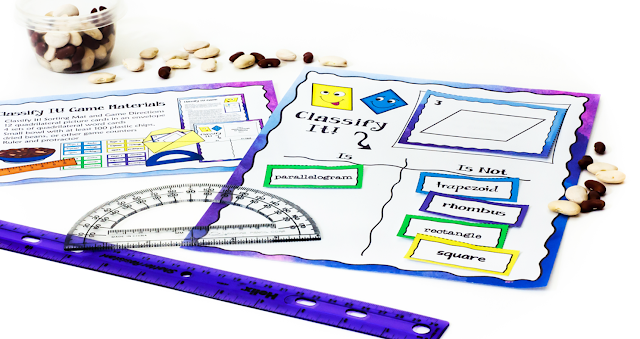

One reason I wanted to bring the tricky trapezoid situation to your attention is that I've recently updated Classify It! Exploring Quadrilaterals to include all three definitions. There are now THREE versions of the lesson materials within the product file.

No matter which definition you're supposed to be teaching, Classify It! Exploring Quadrilaterals has you covered. You'll find lessons, printables, task cards, answer keys, and assessments that are aligned with the quadrilateral classification system used by your curriculum. Not only are these activities engaging and fun for kids, the lessons will help them nail those quadrilateral classifications every time! If you don't believe me, head over to see this product on TpT where you can read feedback from 400 teachers who have used Classify It! Exploring Quadrilaterals with their students.


By the way if you already own Classify It, you can download the updated version for free by clicking over to the Classify It! Exploring Quadrilaterals page on TpT. If you're logged in, you'll see a link at the top that says "Download Now! You own it!"

If you teach quadrilaterals and haven't purchased it yet, take a few minutes to preview it on TpT. If you use it with your students, I think you'll agree that Classify It is the most effective and FUN way to foster a deep understanding of quadrilateral classification!


March 21, 2016

Sweet Statistics: Jelly Bean Data Analysis

Jelly Bean Egg Challenge is a sweet statistics lesson that requires students to measure, estimate, collect, compile, and graph jelly bean data in order to analyze it and draw conclusions.Give each student a plastic egg filled with an assortment of jelly beans, and let the fun (and learning) begin!
I used to think jelly bean math activities had no place in the upper elementary classroom. Sure, sorting jelly beans and graphing them by color is fun, but who has time for “fun” holiday activities when you have a rigorous curriculum to teach? But that was before I realized that you can do a whole lot more with jelly beans than just graph them! In fact, you can turn a fun candy-themed lesson into a powerful learning activity just by sneaking in some challenging academic content!

For example, the Jelly Bean Egg Challenge is a sweet statistics lesson that requires students to measure, estimate, collect, compile, and graph jelly bean data in order to analyze it and draw conclusions. Give each student a plastic egg filled with an assortment of jelly beans, and let the fun (and learning) begin!

April 29, 2014

Math Problems - They're Hiding in Every Story!

Guest post by Susanna Westby

One of the challenges in teaching math effectively, especially as student get older, is finding ways to make it meaningful to their experience. Teachers who have heard students complain, "Why do I need to know this? I will never use it," will know what I mean!

One way to teach the relevance of math in an engaging way is to integrate your math and literature. Within every story there are math problems hiding - my job is to point them out and hopefully encourage students to find their own.

When working with younger students, I simply point out the math I found in the stories we read together, and invite them to help me solve each problem. This can be as simple or complex as you like, so long as it uses elements of the story.

Below are several examples that I've used with my class using both fiction and non-fiction.


The Three Little Pigs
We use fairy tales to introduce the concept of making math stories. For example, after reading the story of the Three Little Pigs, we explore basic operations using characters and events from the story. This is a great vehicle for meaningful math, but also encourages a closer reading of the story for details at the same time. After some examples, I invite students to find their own math connections.

Examples:

  • If each little pig had one cookie, how many cookies would they have altogether? 1+1+1=3
  • If each little pig had 3 cookies, how many cookies would they have altogether? 3+3+3=9 or 3x3=9.


These equations could also be acted out with 3 students holding 3 paper cookies each. It’s a simple concept, but having students organize and “act out” the math problems is beneficial the goal of developing students’ overall math sense.

Here is an example of the recording sheet we use; student work is in red.


A copy of this recording sheet is available to download at the end of this post if you’d like to try it!

The Selfish Crocodile
Using the book The Selfish Crocodile by Michael Terry, we can explore concepts such as counting, doubling, graphing, sorting, and fractions.


Here are the problems my students generated from the picture below:

*Sort the animals below by characteristic and make a graph: animals with horns, animals with spots, animals that are grey, animals that have wings. For this lesson, watching students decide on the sorting characteristics was a great indicator of their understanding.


From the picture below:
  • How many teeth does the crocodile have on the top? How many on the bottom?
  • Add them together for the total: 32+32=64
  • How many teeth are cracked? 1/64
  • What fraction shows how many teeth are on top? 32/64 (or ½) or half are on top.


From the picture below:
  • How many animals are above the water?
  • How many would there be if there were TWICE as many above the water?
  • How many are below the water?
  • How many are half above and half below?
  • How many MORE are below the water than above? Draw pictures to prove your answer.


Deadly Creatures Dictionary
Using the non-fiction book Deadly Creatures Dictionary by Clint Twist, we found measurement questions to explore. We read that a dolphin is 8 feet long. Since we had just recently read a novel about dolphins, students were really interested to see what 8 feet looked like in real life. So, they worked together to measure with rulers and we cut out a life size dolphin. Then we used the dolphin for non-standard measurement, as seen in the photo at the top of this post.

Actual Size
Using the book, Actual Size by Steve Jenkins, we continued this idea of measurement and real-life sizes. (This book shows pictures that are the actual size of various creatures.) We measured the actual size of a giant squid's eyeball (12 inches), cut strings that length, and then recorded things around the room that were bigger, smaller, or the same size as a giant squid's eyeball!


Ordinary Mary's Extraordinary Deed
Some stories lend themselves naturally to math equations. One example is called Ordinary Mary's Extraordinary Deed by Emily Pearson. This is about a girl who finds some blueberries and decides to leave them on the doorstep for a neighbor as an act of kindness. The neighbor is so pleased that she makes blueberry muffins for 5 people. Those 5 people are so pleased that they EACH do something nice for 5 more people, and the total number of people involved grows exponentially, as
illustrated in the chart below. We had a lot of fun keeping track of the people as the story went on, and older students could expand on this idea in all kinds of ways.

Benefits
These are some of the advantages I’ve seen of integrating math and literature in the classroom:
  • It reinforces the idea that math is meaningful and useful in daily life.
  • It creates a habit of looking for math outside of math period, which means more practice outside of the classroom.
  • It’s a wonderful way to challenge your high-level thinkers to create and solve their own math problems.
  • It’s involves questions that are student-generated, which I find leads to more overall engagement.


I hope you'll give it a try the next time you read a story together. You might be surprised at how quickly and efficiently they can make those big connections; I certainly was! If you’d like to use my free recording sheet, just click on the image to download it.


A big thank you to Laura for the opportunity to share these ideas!

Susanna has been teaching primary grades for 20 years and loves sharing ideas with other teachers around the world. Please stop by to visit her at Whimsy Workshop Teaching for more teaching ideas, literacy sets, and teacher graphics!


October 30, 2012

Spontaneity Brings Math to Life!

By Nyla Phillips-Martin, Guest Blogger

Last week, while in the midst of teaching a lesson on cuboids, I quickly realised that I had to do something drastic to get the attention of my most easily distracted student. I mean, there I was feeling all proud of myself for having everything I needed, I had my examples and non-examples for the students to handle, observe and compare attributes. My classroom was buzzing with excitement; hands were fervently flying up during Q & A time as I selected students to answer questions.

But the hand that I was looking for at the front corner of the class never went up. Justin (let’s call him Justin) just sat there looking away from me, tapping his ruler on the desk. Then he poked another student with his pencil. Now, it is not uncommon for him to be like this because he sometimes gets into trouble in order to avoid class work. What I needed to do was to get his attention without halting the momentum that the other students were having. At that moment, an idea popped into my head.

I walked out of the room, spun around and returned with a silly grin and a cuboid net in my hand. I didn't say a word. I just slowly folded the net into a talking cuboid (like a puppet). Think of a box with the top lid open – that flap became the puppet’s mouth. Anyway, I used the silliest voice I could muster and made the puppet talk.

He introduced himself as Corey the Cuboid and went on to talk about his other siblings and the fact that he feels like the odd one out because he cannot roll like the cylinder or sphere and he’s not as cute as his brother the cube. My fourth grade students were wide eyed and everybody was paying attention – not to me the teacher, but to the cuboid on show.

They all wanted to have their turn with handling Corey the Cuboid and making him talk (including Justin). In fact, they had so much fun making him talk that I videotaped one of my students as she brought Corey to life!


I really enjoyed that cuboid net lesson and it taught me that even with a lot of planning, a touch of spontaneity keeps things interesting. The lesson gave me an idea for their math project – to have them put on their own puppet show featuring different talking 3D Shapes.

If you like the idea of having students create puppets from 3D shapes, feel free to use the patterns from this free assortment of 3D shape nets that I created to save yourself some time! And don’t forget to flip out and be just a tad spontaneous!


Nyla Phillips-Martin, is a young wife, mother, and teacher in the Caribbean. She has a B. Ed Degree in Primary Education and is in her seventh year of teaching. She hopes to show other teachers in her country the power of using technology for use in records, planning and especially in the classroom. To her, education is all about fostering creativity and facilitating hands-on learning. Visit Nyla's blog, Nyla's Crafty Teaching, for more engaging lesson ideas!

March 31, 2012

Now's the Time for Math Stations!

Math stations are a great way to reinforce and review skills from throughout the year!
Have you  used math stations or math centers in your classroom this year? If not, this is the perfect time to start! As you prepare for end-of-the-year tests, you need time to work with small groups of students on specific skills. But what are you supposed to do with the other kids? If you set up math stations, the rest of the class can work with a partner or alone on a math review game or activity. This photo shows two of my former students playing a matching math review game. Math stations make the end of the year so much fun!

I've experimented with several methods for using math stations. and I discovered that setting them up wasn't nearly as difficult as I had imagined. Math centers can consist of nothing more than a deck of math cards and a set of directions. I generally used the Rotation Station model or Choice Stations with center menu options. You can learn more about both models on my Implementing Math Stations page on Teaching Resources. On that page, you'll also find some great free math games to use in centers.

Math Stations for Middle Grades (3 - 8)
After years of using math stations successfully, I decided to write an ebook to share my strategies. Math Stations for Middle Grades includes management strategies, prepared math games, and a variety of templates so that you can create your own problems to go along with the games. The item shown here is for a single classroom; I now have a school site license available as well. You can preview everything online before you purchase to see if the materials are right for your classroom.


More recently, I've created loads of freebies and games to use in math centers, and many of them are aligned with the Common Core. Just take a look in my Math File Cabinet to see what you can find!