December 13, 2012

Tips for Using Math Games Effectively in the Classroom


Who doesn't love a game? In the math classroom, games offer an engaging alternative to worksheets, allowing students to work with others and have fun while learning. They’re perfect for practicing new skills or reviewing previously-learned content. Math games are extremely versatile and can be used in cooperative learning teams, in small group instruction, or in math centers.

One key to using math games effectively is to develop clear and specific management systems and procedures. Students need to know when they can play the games, where to go to play them, how to choose a partner, and a host of other procedures.

In this blog post, I'll share a few tips for using math games effectively. I've also compiled some of my best strategies in Tips for Teaching with Math Games, a freebie which you can download from my TpT store.

Using Math Games in Cooperative Learning Teams
Math games work well in cooperative learning teams during whole group instruction or while you are working with small guided math groups. After you introduce a skill, demonstrate it, and check for understanding, have students play a game to practice the skill. When you use games in cooperative learning teams, each team will need a copy of the game materials, and all teams will be engaged in playing the games while you serve as a facilitator. This gives you the opportunity to walk around and work with individual students who may need extra help.

Another way to use games in cooperative learning teams is for reviewing several different skills the day before a test. If you choose to use games this way, you’ll need a different game for each skill and rotate the games from team to team every 10 to 15 minutes. Sometimes you can use the same game but simply create different problem cards or task cards for each skill.

Using Math Games in Learning Centers
Using math game centers is a way to help students keep skills sharp throughout the year. You may want to set aside 15 to 20 minutes a day for students to work in math centers. Having them play the games first thing in the morning as other students arrive can keep them on task and energize them for the day. You can also encourage students to use these activities when they have completed other assignments or while you are working with a small group.


Using Games to Teach Social Skills
Some students have trouble playing games because they don't know how to be good sports. With these students, it doesn't whether they're winning or losing. When they're winning, they gloat about how well they are doing, and when they're losing, they blame other players or complain about their bad luck.

It might be tempting to give these students worksheets to do during math centers or other times when the rest of the class is playing math games, but that's not going to help them learn to be good sports.

One way to work on social skills is to teach a mini-lesson for the whole class on what “sportsmanship” means. The younger your students, the more help they will need with developing social skills for games. However, even older students can benefit from reviewing these skills.

Start the lesson by saying that math games can be fun, but only if the players demonstrate good sportsmanship. Display one of the two charts shown on the right which you can find in the Tips for Teaching with Math Games freebie, or create a chart of your own. Ask students to discuss what it means to be a “good sport” versus a “poor sport” when playing games. During the class brainstorming session, remind them not to name specific people or incidents that have happened in class. Just discuss behaviors such as bragging, taking turns, congratulating the winner, smiling, grabbing the materials, not following the rules, and pouting. Write each behavior on the class chart, and then finish the discussion by reviewing how to be a good sport.

Another helpful strategy is teach your students how to deal with common tasks such as deciding who goes first or who will shuffle the deck of task cards. Rather than arguing, they can flip a coin, play Rock-Paper-Scissors, or toss a die. After you address these issues with mini-lessons, you’ll find that your students enjoy playing games more and get along better with their peers.

Wrap up the mini-lesson by reminding your students that although they might not win every game, they are all winners because they are having fun while they learning.

Where to Find Fun and Effective Math Games
You can create your own math games, but they are time-consuming to make. If you don't have the time or the desire to create your own, check out the collection of games in my Math Games Growing Mega Bundle. I LOVE creating math games that are engaging, fun, and most importantly, effective learning tools.

All of the math games in this bundle are appropriate for upper elementary students, and many can be adapted for younger or older students by changing the task cards. Each game includes teacher directions, ready-to-use printable game materials, and answer keys. Some of the games also include QR code answers as well as traditional answer key.

My Math Games Mega Bundle includes 16 games right now, but that's likely to change. I refer to it as a "growing" bundle because when I create more math games, they will be added to this collection. Anyone who has already purchased it will be able to download the new games for free.

All of the games in this bundle can also be purchased separately. To preview any of these math games, just click on its cover image below. You'll be taken to a page in my TpT store with more information about the game, thumbnail images, and a link to preview every page in the game. If you like them all, you'll save 30% by purchasing the entire bundle.

Where to Grab Your Tips for Teaching with Math Games Freebie
If you enjoyed the tips I shared in this post, be sure to download my free PDF, Tips for Teaching with Math Games, which includes even more tips for teaching with math games.

How do you use math games in your classroom?  Do you have any tips of your own to share?


December 6, 2012

Gifts for Santa's Scientists

What would YOU give an ornithologist for Christmas? What about an ichthyologist or a paleontologist?

Santa has a bag of gifts for a dozen scientists, and he needs YOUR students to help him figure out which gift goes to which scientist. But first, they’ll need to do a little research and work with their teams to learn about a dozen different types of scientists. Curious? Let me share a little bit about this activity with you.

Gifts for Santa’s Scientists is an engaging research lesson that I developed for my students a few years ago, and it worked like a charm for keeping them on task during the busy week right before the holidays. Before you read on to learn more, you might want to click this preview link and scroll through the document to see what's included in the lesson. I've created a complete packet of printables, directions, and an answer key to make it really easy to implement.

Gifts for Santa's Scientists
To begin the activity, tell your students that Santa has gifts for a dozen scientists in his sack, but the gifts aren't labeled with names. Santa needs their help to figure out which gift to give to each scientist. This activity does not involve an actual gift exchange; students will simply be discussing the gifts named in Santa's bag, like a telescope, a magnet, or a flower pot.

Working in teams of four, each student will research three scientists and complete an activity page like the one shown on the right. They write a sentence or two to describe each scientist's area of study and draw a simple illustration of something those scientists might study. After students finish with their research, they return to their teams to share and record what they've learned.


After they complete this step, the fun begins! They work together as a team to match each gift in Santa’s bag with the scientist names on the packages. To make the activity even more challenging, you can ask students to put away all of their study materials and try to match the gifts and scientists based on what they remember.

My students really enjoyed this activity, and I loved that fact that they had to conduct research, work with a team, and do some critical thinking in order to figure out which scientists received which gifts.

You can find Gifts for Santa's Scientists in my TpT store. One thing I love about TpT is reading the comments and feedback from teachers who've used my materials. This comment from Selina Smith about Gifts for Santa's Scientists made my day!
"I can't say enough wonderful things about this product. It is SO well thought out. It is perfect for students who need help with research. It is perfect for incorporating technology. The directions are so clear you could easily pick it up 3 minutes before class and be ready to teach the lesson. I love how she has written Day 1 number 1, 2, 3, etc. Thank you for making such a great product! I want MORE :)"
Holidays Around the World
The week before Christmas vacation is often a crazy time, and the excitement of the upcoming holidays makes it tough to keep students on task. Textbook lessons won’t hold their attention, so cooperative learning lessons like Gifts for Santa’s Scientists offer a welcome change from regular daily instruction. If you prefer an lesson that involves a variety of winter holidays, you will find a similar cooperative research activity in my December Activities Pack called "Holidays Around the World."

By the way, the ornithologist received a bird feeder, the ichthyologist received scuba gear, and the paleontologist received fossils. I’m not sure about you, but I think Santa could have saved himself the trouble and just given them all iPads! What do you want for Christmas?


November 16, 2012

Literature Circles Made Easy - New Resources


New Book Recommendations and More!

The weeks between Thanksgiving and Christmas can be a challenge for you and your students. Everyone is excited about the upcoming winter holidays, and it’s hard to keep kids focused on their work. This is especially true in reading, because when students are reading or working quietly on assignments, their minds can easily wander. Literature Circles to the rescue! This instructional strategy is fun, engaging, and effective, and now is the perfect time to get started!

If you've never tried Literature Circles, you might be wondering what this strategy is all about. Literature Circles are often called Book Clubs, and they operate much like adult book clubs. In a nutshell, students form groups by selecting books that interest them. Then they meet regularly with other students who are reading the same book to discuss what they’re reading. If Literature Circles sound a bit overwhelming, don’t worry! I’ve compiled an entire collection of resources on my website, including some wonderful new book recommendations, to make them extremely easy to implement.

Literature Circles Freebies on Teaching Resources 
About 15 years ago when I first started my Teaching Resources website, I created a page to gather and share free Literature Circle resources. I eventually added so much content that I had to divide it into several different pages by category. You’ll find descriptions of different Literature Circle strategies, a free webinar recording in which I explain how to implement Literature Circles, and tips for managing Literature Circles in your classroom. Best of all, you'll find page after page of free printables including graphic organizers, organizational tools, and other resources to help you get started. After you finish reading this blog post to learn about my other resources on this topic, you’ll definitely want to visit the main Literature Circles page on Teaching Resources.

Classroom Book Clubs
Teachers used to assign roles in Literature Circles, but that’s no longer the norm. I experimented with Literature Circles for many years and eventually developed an effective and fun method that does not use roles. This method worked so well for me that I created a slidecast eLearning course to share my strategies with others. Classroom Book Clubs: Literature Circles Made Easy consists of a series of short videos in which I share a step-by-step method for getting started with Literature Circles. This teaching resource is available on CD or as a digital download, and it includes student printables and organizational forms. If you’d like to know more, you can watch a short video on my Literature Circles page on Teaching Resources. You can also preview the complete packet of printables online.

New! Literature Circles Book Recommendations
One of the most critical elements of developing a great Literature Circles program is locating terrific books for students to read and discuss. Unfortunately, this step can be difficult and time-consuming because after you locate the books, you need to find time to preview them before sharing them with your class. Fortunately, help is on the way!

A few months ago, I embarked on a major undertaking – to create a huge collection of Literature Circle books recommended by teachers for teachers. I’m excited to announce that Favorite Literature Circles Resources is now live on my website. Here you can find book recommendations for professional reading as well as four pages of book recommendations for students in one convenient location. The student books are categorized by genre, and you can click the book covers on those pages to read more recommendations on Amazon.com. I’m working to add links to the audio CD versions of those books so you can differentiate instruction for your struggling readers. The audio versions will also save you time because you can listen to them to preview the books before using them with your class.

Collaborate and Share
What’s your favorite book for Literature Circles? If you would like to help add to the growing collection of teacher recommendations, click this Google Doc link to share your favorite title with us. From time to time, I’ll update the pages with new book titles, and I may use your suggestions to create a downloadable list of recommendations. Click here to sign up for my free Candler's Classroom Connections newsletter to be sure you're notified of new resources on this topic.

Good luck with Literature Circles! I hope these resources help you and your students enjoy the weeks between Thanksgiving and Christmas, making this an enjoyable and stress-free time in the classroom!


November 4, 2012

Favorite Read Alouds for November


November is a great month for read-alouds! Here are a few of my favorites for Thanksgiving and Veteran's Day. These short picture books are perfect for upper elementary students and work well with many fall-related activities.

November is a great month for reading aloud! Here are a few of my favorite books for Thanksgiving and Veteran's Day. These short picture books are perfect for upper elementary students and work well with many fall-related activities. At the end of the book list, you'll find a link to my November Activities pack which includes activities for many of these titles.

If you aren't familiar with these titles and would like to read more reviews, detailed descriptions, or purchase the book, you can click on the title or cover image, and you'll go right to it on Amazon where you can get more information! I also recommend that you locate your books several weeks in advance of the lesson so you can read them and make sure they are right for your class.


Thank You, Sarah: the Woman Who Saved Thanksgiving 
By Laurie Halse Anderson and Matt Faulkner

Thank You, Sarah is a wonderful book about the history of Thanksgiving in the United States and how Sarah Hale helped make it a national holiday. It's great for teaching students about the "power of the pen" and how one person can make a difference.


If You Were At the First Thanksgiving 
By Anne Kamma

If You Were at the First Thanksgiving is a great nonfiction book organized in a question and answer format. It provides information about the first Thanksgiving as well as information about how the Pilgrims lived when they first came to America.


Oh, What a Thanksgiving!
By Steven Kroll and S. D. Schindler

Oh, What a Thanksgiving! is perfect for comparing and contrasting Thanksgiving today with the traditions observed by the Pilgrims. Children today will find that Thanksgiving long ago was much different!


'Twas the Night before Thanksgiving
By Dav Pilkey 

This hilarious book takes the form of a long, illustrated poem with a single stanza on each page. While the stanzas are similar to the traditional Christmas poem, the story is anything but traditional! Your students will love the surprise ending!


The Wall
By Eve Bunting and Ronald Himler

The Wall is an excellent book to read to students when discussing Veteran's Day. It's a touching story about a boy who travels to the Vietnam Veterans Memorial with his father to seek out his grandfather's name.


I hope you enjoy sharing these with your students as much as I do. They are a great way to foster a warm holiday spirit in the classroom. You can also find activities for many of these books in my November Activities from Teaching Resources Mini Pack.

If you have a favorite book for November, please share your suggestions in a comment on this post. Happy reading!


November 1, 2012

Thankful Writing Craftivity

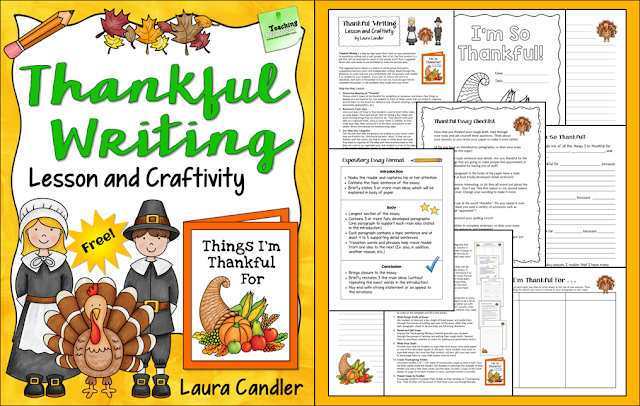
Thankful Writing is a freebie from Laura Candler that's a step-by-step writing lesson and a craftivity all in one.The final project is sent home with students to be shared with their families on Thanksgiving day, and it's sure to be a memorable keepsake!
Free Thanksgiving Writing Lesson and Craftivity!

November is finally here, and what better time to think of all of the things we are thankful for? This topic might seem may seem trite and overdone for a writing assignment, but we can never overdo the message of learning to show appreciation for the people and things that make our lives rich and fulfilling.

Fortunately, this topic also makes a great first expository essay for upper elementary students because it's so easy to organize and write. Yes, it does involve "formula" writing, but I believe in starting out with one formulaic essay to teach students an easy way to organize their thoughts into a coherent paper. I loved having my students write about the people and things they were thankful for because it helped them focus on the positives in their lives, and their final essays made a nice gift to their families on Thanksgiving Day.

Thankful Writing is a freebie from Laura Candler that's a step-by-step writing lesson and a craftivity all in one.The final project is sent home with students to be shared with their families on Thanksgiving day, and it's sure to be a memorable keepsake!The final step of the activity is what makes this project really special. After student write the final drafts of their papers, they staple them into a folder made from a large sheet of colored construction paper. Each student decorates a cover and glues it on to the front of his or her folder to create a special keepsake. If you really want to turn this activity into a full fledged "craftivity," provide plenty of time and lots of creative materials for students to use when decorating their Thanksgiving folders to take home.  Having students add a small photo and the date is a nice touch because many families will treasure this special gift and keep it for many years.

Thankful Writing Craftivity Freebie

My "Thankful Writing" activity became a yearly tradition because it was such a terrific writing activity, and it was so appreciated by my students' families. Because it worked so well for me, I wrote up the complete directions to share with others as a freebie. It's my little gift and my way of showing my appreciation for the many educators who have shared so much with me through the years. The packet includes complete directions, a graphic organizer for brainstorming, and directions for introducing students to expository writing. You can download it from my Seasonal Page on Teaching Resources during November, and my newsletter subscribers can find it on Laura's Best Freebies page any time of the year.

Thankful Writing is a freebie from Laura Candler that's a step-by-step writing lesson and a craftivity all in one.The final project is sent home with students to be shared with their families on Thanksgiving day, and it's sure to be a memorable keepsake!

Tips for Success

Here are a few things to keep in mind that will help make this activity a success.
  • Timing - If possible, start on this activity several weeks before Thanksgiving, especially if your students have not written an essay before. You'll be surprised at how much time it takes to brainstorm ideas, teach them the format, write the first draft, revise and edit it, and create the final draft. You should also allow plenty of time for students to decorate their covers. 
  • Grading - If you are spend spend several weeks on this activity, you'll probably need to assign some sort of grade to it. You could do a participation grade based on overall effort and quality of work. If you need to write comments on their work to justify your grade, you won't want to write in the copy that students are going to give to their parents. What I did was to make a copy of the essay for myself so that I could write comments on it. I felt that since this was their first expository essay, it was more of a learning activity than an assessment so I tended to grade it very leniently. Most of my comments and feedback took place during the writing conference so my final grade ended up being more of a participation grade than anything else.
  • More Cover Options - I recently revised and updated this freebie, and it now includes a coloring page that you can print for students who might obsess over decorating their covers. However, I think most parents would rather see original artwork on the cover. One option might be to have the create the traditional hand-tracing turkey as the cover art. Check out this version that I found on Enchanted Learning for a slightly different approach. 
The day before Thanksgiving, provide time for students to share their final writing projects with their classmates before they bring them home to present to their families. You'll find this to be a nice way to end the day before you send them off for the holidays!