Showing posts with label motivation. Show all posts

April 15, 2015

Motivate Students to Take Charge of Their Learning

No matter how much you love teaching, it's easy to get discouraged this time of year. There's so much left to do, and not enough time to get it all done. Spring fever always hits at the worst possible time - right before testing! How do you respond? If you're like me, your natural reaction is to push your students harder and harder academically, ignoring all signs of their resistance, until you reach the end of your rope!

When you get to this point, it's time to take a deep breath, calm down, and accept the fact that something has to change.

But what? And how can you turn things around and end the year strong?

Believe it or not, it IS possible to regain your enthusiasm and get your class back on track. But you need more than motivation... you need practical strategies and concrete action steps to take today. Angela Watson's newest book, Unshakeable: 20 Ways to Enjoy Teaching Every Day ... No Matter Whathas that and more! Every chapter is AMAZING, filled with wisdom, encouragement, and specific strategies to implement right away.

Angela Watson is the teacher who created The Cornerstone for Teachers website, and she's been sharing awesome resources with teachers for years. This is her 4th book, and it's just as inspirational as her others. I was excited to be invited to participate in a blog series that examines each chapter in Unshakeable, day by day. Today is Day 15, so I'll be sharing my insights about Chapter 15, "Motivate Students to Take Charge of Their Learning." You can find all 20 chapter reviews on her Unshakeable page, where you can also download a list of all 20 chapter titles.


Why Kids Need to Take Ownership of Learning
Reading Chapter 15 was a joy! Angela confirmed something it took me 20 years to figure out: when kids take ownership of their learning, they work harder, make greater academic gains, and ultimately discover the joy of learning for its own sake. Angela makes a case for motivating students by giving them choices whenever possible, and I agree. Student choice makes all the difference.

You might be thinking, "What? I'm the teacher! I'm the one who will be held accountable for what they learn or don't learn! I can't give them too many choices because I have a curriculum to teach!"

But stop and examine that thought. Yes, administrators will be holding your feet to the fire if your students don't make academic progress. But, ultimately, who will pay the biggest price? If your students don't learn the skills they need to survive in a world that's ever changing, THEY will feel the affects for the rest of their lives! When kids stumble through each school day like zombies, following directions but never asking questions or caring why they need to learn, they are setting themselves up for a lifetime of failure and missed opportunities. They need to feel a sense of ownership and responsibility for their own learning.


How To Motivate Kids to Take Ownership
So how can you cover everything in your curriculum, yet provide opportunities for student choice and ownership? Here's the key: You might not be able to let them choose WHAT to learn, but you can give them some choice in HOW they learn.

Easier said than done, right? Normally I would agree, but Angela makes it easier than you might imagine. Unshakeable includes loads of practical strategies for teaching kids how to take charge of the learning experience. Here are a few of the methods Angela shares to motivate students:  
  • Teach kids to use technology for both content consumption and content creation
  • Personalize learning with student-directed projects
  • Give self-assessments for students to reflect on their progress
  • Let your students help develop assessment rubrics so they understand how they are being graded
  • Conduct student-led conferences 
Each of these ideas is covered in Chapter 15 in great detail, with classroom examples and specific strategies. You'll find yourself jotting notes in the margins and filling the pages with sticky notes so you don't forget a single great idea!

Motivate Your Students to Motivate Yourself!
What does motivating your students have to do with YOUR own motivation, or lack of it? Remember how I said it took 20 years for me to discover the importance of kids taking charge of their learning? When I finally let go of the need to control every aspect of the learning process, I started to enjoyed teaching more than ever. I loved coming to school each day and learning right along with my students. Not surprisingly, these changes resulted in measurable academic growth for them, too!

Angela  sums it up really nicely, "Any topic instantly becomes more fun and meaningful for everyone involved when the kids are given some ownership of how they learn." When your students begin to ask thoughtful questions, make choices, and take an active role in the learning process, they blossom right before your eyes, and it's a joy to watch!


Angela is the creator of the Truth for Teachers podcast series, and she has a short podcast called How to Motivate Students to Take Ownership of Their Learning. You can download it for free from her website and listen to it on your way to work!

Where to Find Unshakeable
What if you're still going strong and you don't need motivation to finish out the year? You'll love Angela's book anyway! Reading it will reaffirm the best practices you're already using, and you'll learn new techniques to add to your bag of teaching tricks. You can get the Kindle or paperback edition of Unshakeable: 20 Ways to Enjoy Teaching Every Day... No Matter from Amazon.com or from Angela's website. Read a chapter a day and enjoy 20 days of inspiration!


Affiliate links are included in this post.

November 13, 2014

20 Tips for Motivating Gifted Kids to THINK!

Advice from Real Teachers Series

Chances are good that you have at least a few gifted children in your classroom, even if they aren't formally identified as being gifted. These students can be a joy to work with, but it does take a special teacher to know how to motivate them to set high goals for themselves and being willing to take on challenges.

Today's Question
Taylor is a fan of the Teaching Resources Facebook page who asked, "I'm working with a great group of gifted students. The only problem is that some of them don't like to have to think because they're used to everything being so easy. How do I motivate my top students to want to push to the next level? How do I get them to want to dig deep and not just to be masters of the surface level?"

Encouraging a Growth Mindset
Dozens of teachers shared their expertise in responding to Taylor's question, and many of them referred to Carol Dweck's work on encouraging students to develop a "growth mindset" where they accept challenges and see the value in tackling difficult work. Dweck wrote, Mindset: The New Psychology of Success and it's a life-changing resource. If you aren't familiar with her work, watch this fascinating YouTube video that gives a great overview of some of the most relevant information for teachers. If it interests you, purchase the book to learn more.


Top 20 Suggestions for Motivating Gifted Kids to Think
Here are 20 of the best suggestions for motivating gifted kids to stretch themselves and reach their true potential. If you would like to read them all, click over to my Facebook page where you'll find them.
  1. Steve Miller - Raise the rigor and your expectations. Failure IS an option in the real world. This means YOU have to be more rigorous in designing, prepping and executing difficult concepts. Your kids will step it up only when YOU "teach it up." The first grades will be a wake-up call. Reel 'em in and teach!  That's what all of us were called to do!
  2. Matt Squires -They're used to being praised on their intelligence, not their effort. They do not have 'growth mindsets.' (Watch this YouTube this from Carol Dweck- it's incredible stuff). Make a huge effort to reward and praise their effort , not their intelligence and natural talent.
  3. MeLinda Gray -The main thing to focus on is what they are interested in. Are they gifted in your content area?  If they have are identified gifted you need to know in which subject areas. Then, remember it is not giving them extra work, but giving them challenging work that is on a different level than the regular ed students, if you have any regular ed kids.  After that, find out what they are interested in and try to design lessons, reading, etc, around those interests.  Using webquests online can be a huge help in language arts, plus they love using the internet.  It is a lot of extra prep, but they will really start responding and it will be so worth it.
  4. Mary Breveleri - Asking for evidence to back up an answer can get them to think deeper.  What did you read or see that makes you say that?  Deeper questions will result in deeper answers. Surface questions will result in surface answers. :)
  5. Sarah Smith - I had the same problem with my high math group. I would have the class solve a problem and choose 3-4 students with different answers or methods of solving the problem and have each student explain their solution and how they got there. I would then have the rest of the class debate on who was correct and why. It really made the students think about their own thinking (if that makes sense).
  6. Mary Moncus - We do team competitions.  My gifted kids are very competitive and working in small groups they can help and motivate each other.
  7. Pam Dobrowski - I have to give them graphic organizers that prompt their thinking otherwise they won't give me what I know they can do. I teach second grade.
  8. Cathleen Triplett - Project Based Learning:  Have them brainstorm problems in the community and research and solve them. They could create a website to show what they've learned and educate others.
  9. Morgan Callahan - Try the book Your Fantastic Elastic Brain! Great for teaching kids how we can expand our minds.
  10. Zanda Clearbrook - You could try a flipped classroom, or at least incorporate some aspects of it. Give them the information up front, and they come back and do some kind of research/project that shows their understanding of it. Layered Curriculum could also be a choice to use, but that takes a bit to set up the first time.
  11. Michelle Watt - The important thing to remember about gifted students is to challenge them to go deeper not broader. Also, reward the process rather than the right answer. Research fixed vs growth mindset. They have likely been rewarded for always getting the correct answer rather than their thinking process.
  12. Lorri Hurst - Use guided inquiry to push them outside of their comfort zone.  I do this with my AP students all the time.  When they ask me a question I ask one in return.  Ask questions to guide them to the place they need to be. You may have to explain this to your principal and even send a letter of the change in expectations.  Make sure you explain your goal is to produce the Best Most Productive student you can.....thinkers not memorizers!
  13. Connie Copenhaver - The passion and drive GT students need are firm, fair, expectations from a teacher who embraces growth mindset and gives challenge, rigor, enthusiasm, to academic choices to student-driven projects.  Allow the GT students to soar and be guided by you.  Give room to grow within your lesson standards.  Do not fear the what ifs...allow students to truly enjoy and engage in self-selected projects within a good question as stated in genius hour standards. You will see such joy of learning like never before!  It will transfer into all areas in your classes.  Good  luck!
  14. Kathryn Rasinya-White - Give them CHOICE! Find out what interests them and let them explore that topic using a multidisciplinary approach.
  15. Kathleen Curran - Read the book Mindset by Carol Dweck. By focusing on a growth mindset it may get them working more. They're used to being praised for how smart they are, not how hard they work. Works for low students as well
  16. Granny Bee - Genius & Passion Projects. STEM & STEAM. Anything where they get some choice and they have to set goals. Odyssey of the Mind. I tell my smart ones if they don't challenge themselves they are going to get lazy. Rabbit & the hare? The slow and steady ones will pass them up.
  17. Stephanie O'Moghrain - Genius Hour!!!  Google it, and spend about 6 hours absorbing all the info.
  18. Patricia Sardina - Try to change their mindset. If they've always been told that they're gifted failing might make them feel awful! The frustration would be just the beginning... Instead of everyone telling them how smart they are, go for, "You can learn anything." This implies a process; trying, and failing and trying again until you've got it right. If they believe that being challenged will help them learn more and keep them at the top they will go for it! Make it a game if you can: "let's see how many new words you can learn this week" or "What do you think is the best way to do this?" Good luck!
  19. Pe Howell - Give them some challenges. Can you assign a project on a topic of their choice that utilizes some of the skills you want them to enhance?
  20. Reuben Hks - Try using Kaplan's icons of depth and complexity. Here is a link to some information about them from Byrdseed.com, which is also a great website for GATE ideas. 
Do you have any of your own strategies to share? If so, please post it in a comment below. If not, which strategies in this post interest you? 

If you would like to submit a teacher question of your own, be sure to watch for the Question Connection announcement every Wednesday at 8:30 pm EST on the Teaching Resources Facebook page. Even if you don't have a question, please follow me on Facebook and offer your advice when you see the questions come through! Working together, we can accomplish more!


March 21, 2014

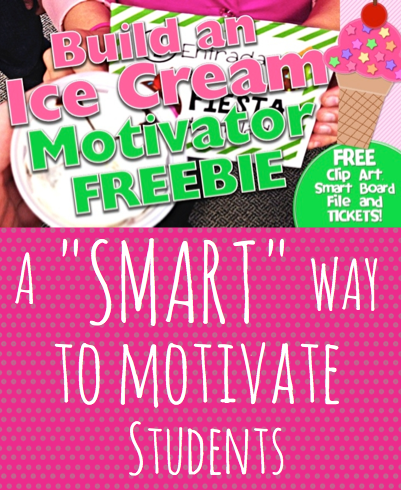
A "Smart" Way to Motivate Students

A "Smart" Way to Motivate Students
Hey, ya'll! My name is Tabitha Carro of FlapJack Educational Resources, and I am more than stoked to be here at Laura Candler's blog, guest-posting for her. A very huge thanks, Laura!

My motto is "Have fun, the learning will come!" So, I wanted to share with you a fun way I motivate my students to reach goals as a class. It's called Build-an-Ice Cream Student Motivator, and I created it to use on the Smartboard. This is a great strategy, especially if students need something fresh and new to motivate them (and sweet!). If you don't have a Smartboard, I'll explain how you can adapt the idea.

Basically, once all students have reached a certain goal of five objective (whatever you decide - math facts, reading log, behavior, etc.), they get to have an ice cream celebration! What's more fun than that??

To explain it to you, I've made a YouTube video that shows exactly how it works. Just click here or on the image below.

http://youtu.be/hqPP1-yVe8k

After watching the video, be sure to pick up all your freebie items at my TpT store! They include:

SMART Board Build-an-Ice Cream File

Ice Cream Party Tickets in English and Spanish

And Ice Cream Clip Art for you to use whenever and however!


If you don't have a Smartboard, I have a solution for you. If you've read Laura's Book Mastering Facts Multiplication and Division, this activity can go right along with her ice cream celebration for learning math facts. So if you don't have an interactive whiteboard in your classroom, you can use a combination of my system and the one that Laura shares in her book. Hope you enjoy using this with your students! Thanks so much!

Tabitha Carro
http://www.flapjackeducation.com/

Tabitha Carro is the creator of the Flapjack Educational Resources blog where she loves to share ways to make learning fun. She started her teaching career in the kindergarten classroom and is currently teaching in SC as a Spanish partial-immersion math and science 4th grade teacher. Tabitha enjoys creating videos for teachers; follow her on YouTube to be sure you don't miss a single one!

July 28, 2012

Motivate with Brain Bucks!

We can debate the pros and cons of using rewards in the classroom, but the fact remains that our lives are filled with both intrinsic and extrinsic rewards. Even as adults, many of us motivate ourselves with extrinsic rewards, such as promising ourselves a special treat when we meet a personal goal.

In the classroom, students who get the right answers on tests are rewarded with good grades and often other tangible items such as certificates and trophies. But when do we reward students for creative thinking or being willing to persist in search of the right answer?

A few years ago I created "Brain Bucks" to reward students for finding creative solutions to problems or putting forth extra effort in completing assignments. I even used them to reward students for catching me in a mistake! I kept an envelope with Brain Bucks at my teaching station and looked for opportunities to reward good thinking. When someone came up with a new way to solve a problem or answered a question that had stumped many others, I handed that student a brain buck and said something like, "Wow! Way to use your brain today! I would never have thought of solving the problem that way!" My students quickly realized that I valued creative THINKING more than simply getting the right answer. Eventually, other students began to look for good thinking in others. I would frequently hear someone say, "Mrs. Candler, I think she deserves a Brain Buck for that idea!"

You can download your own Brain Bucks for free from the Classroom Management page on Teaching Resources. They are available in green and also in black and white if you prefer to print them on green paper.

Classroom Economy Freebie
Since Brain Bucks are just slips of paper and not real money, students need to be able to redeem them for something else that they value. I connected them to my full classroom economy system. Students earned money for jobs in the classroom as well as for having their homework for the whole week, and that class money could be used in our class auction at the end of each grading period. You can read more about my classroom economy system in the Classroom Economy freebie. Just download it from my TpT store to get started.

Brain Bucks are a fun, effective, and cheap way to encourage students to think outside the box! For more ideas on classroom reward systems that might work with Brain Bucks, take a look at the responses to a question that was posted on my Facebook page. You'll find dozens and dozens of great ideas there! If you find new ways to use Brain Bucks in your own classroom, please share them here!


Laura Candler, Teaching Resources