April 8, 2014

The Question Connection: Advice from Real Teachers


Got teacher questions? Ask and answer them on the Teaching Resources Facebook page because the best advice comes from real teachers!
Got Teacher Questions? 
Ask and Answer on Facebook!

Read this post to find out about the Question Connection, and then submit your question HERE.

When I first started teaching I was full of questions, and I continued to have questions when I tried new strategies or ran into difficulties. It used to be that we could only seek help from educators we knew personally, but thanks to the Internet, it's easy to ask hundreds or even thousands of teachers for advice!

Facebook is the place to collaborate and now more than ever, teachers are connecting in groups and on pages to help each other. Lately I've been posting Facebook requests for teacher questions and within an hour there will be dozens of questions asked. I repost one or two of the questions each day to all 560,000+ fans, and I'm always amazed at the spirit of collaboration as others jump in to help.

The Question Connection 
To make it easier for teachers to ask and answer questions, I started a regular feature called the Question Connection. To simplify the process, I created a Google Doc form where you can submit a question, and this is also the method to use if you want your question posted anonymously. I'll also post a reminder once a week on Facebook along with one of the Question Connection images on this page. Here's how to participate:
  1. Follow Teaching Resources - Visit my Teaching Resources Facebook page and be sure you have liked it. Then hover over the Like button at the top and be sure that the words "Get Notifications" and "See It First" are checked. If you don't take this step, you won't know when I've posted your question! 
  2. Ask a Question Now - If you have a question right now, click this Google Doc Form and fill it out. Provide details about your situation and grade level that will help others respond, but don't reveal too much personal information about your school or students. 
  3. Ask a Question Later - If you don't have a question right now, pin the image above to one of your Pinterest boards so you can return to this blog post later. Or if you see the Question Connection post on Facebook, you can ask your question in a comment under that post. 
  4. Answer a Question - You might not have any teacher questions of your own, but you might enjoy responding to one of the questions posted. If you can help, just use the reply feature and respond directly to the person asking the question. 
I'll regularly review the questions that are submitted, and I'll post the ones that seem most relevant to the followers of the page. Remember that I created the Teaching Resources page to support elementary educators, so I'll select questions that are relevant for that audience. Questions that go out to everyone often receive over 100 terrific responses! Follow me on Facebook and be sure to watch for your question to be shared!

Got teacher questions? Ask and answer them on the Teaching Resources Facebook page because the best advice comes from real teachers!

What to Ask
Feel free to ask about anything related to teaching or elementary education, but please don't ask something that you can easily Google yourself. Ask the types of questions you would ask a trusted colleague. Here are a few ideas to get  you started:
  • Share an upcoming lesson topic and ask others to recommend great resources and teaching ideas that have worked for them
  • Ask for advice about classroom management, parent communication, dealing with difficult situations at school, etc.
  • Ask how other teachers are using technology or specific websites
Responding to Questions
Got teacher questions? Ask and answer them on the Teaching Resources Facebook page because the best advice comes from real teachers! Questions are only one half of the Question Connection! We also need educators who are willing to answer questions and share ideas. Don't be shy about responding! When you read a question, think about your own teaching experiences to see if you can make a connection. Even if you're a new teacher, you've learned valuable information that can benefit others. Share successful teaching strategies, links to free resources, book recommendations, helpful advice, or best classroom practices. However, please refrain from self-promotion or providing links to teaching products.

Advice from Real Teachers
I love reading all of the responses to each question, and it concerns me that after a few days all of that great advice is lost in Facebook land, never to be found again. That's why I introduced a blog series called "Advice from Real Teachers." When I see a question that receives a massive number of responses, I'll select the top 10 or 15 comments to share here on Corkboard Connections.

If you ever feel hesitant to ask a question or respond with a suggestion, remember that your collaborative efforts benefit many, many other educators. Your question may spark a great discussion that leads to someone else learning a new strategy or discovering an amazing resource!

Great Questions + Advice from Real Teachers = The Question Connection! Enjoy!


April 1, 2014

Show What You Know!

What keeps cooperative learning from becoming chaotic? Structure, equal participation, and individual accountability! When all students are actively engaged, there's no time for misbehavior and learning is multiplied!

Individual dry erase boards are essential if you want to foster active engagement. One of my favorite cooperative learning activities involving dry erase boards is "Showdown." This strategy includes all of the elements that make cooperative learning lessons successful. It has a clear structure, students participate equally, and all team members are held individually accountable for their own work.

If you are a fan of Kagan Cooperative Learning you've probably heard of Showdown, but you might not know that I invented it! I developed this activity many years ago when I was writing Discovering Decimals Through Cooperative Learning. Having been thoroughly trained in Kagan strategies, I knew every structure inside and out. So I was baffled when a cooperative learning activity I was using in my classroom didn't fit any of the structure descriptions. I contacted Dr. Kagan and explained the steps of the activity. After we talked it over, he agreed that it was a brand new cooperative learning structure! He named it Showdown, which was perfect! In this activity, students record responses on individual dry erase boards, and when the Leader says, "Showdown!" they all display their boards to "show what they know."

Showdown Directions
Seat students in teams of three to five and give each person a dry erase board, eraser, and marker. You'll also need a set of problem cards or task cards for each group. Designate who will be the first Leader in each team. The basic directions are outlined below; printable directions can be found in all of my Showdown freebies and products on TpT.
  1. Stack the problem cards face down in the center of the team. (If the cards have answers on the backs, place them face up).
  2. The Leader reads the first problem aloud and places the card face up in the center of the team.
  3. Without talking, everyone (including the Leader) writes the answer on his or her own dry erase board.
  4. All students place their dry erase boards face down when finished.
  5. The Leader says “Showdown!”
  6. Flip over dry erase boards and show answers. Check the answer by looking on the back of the card, using a key, or referring to another source like a textbook. Discuss answers that are different and  celebrate correct answers. 
  7. If everyone had the correct answer, remove the card from the deck. If not, place it at the bottom to repeat later.
  8. Rotate Leaders clockwise for each round. Repeat as time allows.

Cooperation - Not Competition!
Have you noticed that I don't refer to Showdown as a game? That's because students are cooperating with each other, and there's no competition at all. No one scores  points for correct answers and no one is penalized for incorrect answers. Students are not allowed to talk while they are working in Step 3, but after the answer is revealed, they are encouraged to help anyone who had difficulty with the problem. 

Tips for Using Showdown
Showdown is a fast-paced, interactive, and fun way to review content and skills. However, it does have some limitations. Showdown is not designed for in-depth problem-solving or discussion; other cooperative learning strategies are more suited for critical and creative thinking. Showdown works best when team members are not too far apart in ability level, so you may want to reseat your students for the activity and provide each team with differentiated task cards. Students who need additional support may need an assistant or parent volunteer to provide help after each round.

Younger students may not be ready for the team Showdown directions above, but students of any age can participate in Class Showdown. In this variation, the teacher is the Leader and directs the entire activity. The task cards are displayed on an interactive whiteboard or with a document camera or overhead projector. It's a quick and easy method of informal assessment to help the teacher determine who understand the concepts being taught and who needs additional help.

Ready-to-Use Showdown Activities
Over the years I created dozens of sets of task cards for Showdown, and you can find them in many locations on my Teaching Resources website as well as in my TpT store.  

Showdown is excellent for math practice, and you'll find many free math task cards in my Math File Cabinet, including the Round and Compare Decimal Review Cards on the Decimal Files page. Just cut these cards apart, stack a set in the middle of each team, and you're ready to go. Nothing fancy ... but very effective!

Download this freebie from Teaching Resources.

Showdown is a great strategy for reviewing grammar skills, too. You'll find many Showdown task cards in my Language Arts File Cabinet including free Quotation Mark Task Cards and Subject and Predicate Task Cards. On that page you'll find a link to my newest Common Core Aligned product, Plural or Possessive? Task Cards and More! This complete digital resource includes lessons, tasks, cards and directions for Class Showdown as well as Team Showdown. Preview it online to see if it meets your needs. You can also download one or more sets of division task cards to use with Showdown.

Download Plural or Possessive? Task Cards and More! from my TpT store.

Download Division Task Cards from my TpT store.

Suggest a Task Card Set!
What sets of task cards do you need? Tell me what you want, and if I create that set and you are the first to offer the suggestion, I'll send it to you for free! Just complete this Google Doc form and let me know. If you have more than one idea, fill out the form once for each idea. Provide as much detail as possible about the types of questions or problems you want and include your grade level in your request.

Showdown Wrap Up
What do kids think of Showdown? They love it, of course! Technically it's not a game because there's no competition, but it's exciting and fast-paced so it feels like a game. With Showdown, there are no losers ... in fact, all students are winners because they are having fun while learning!


March 21, 2014

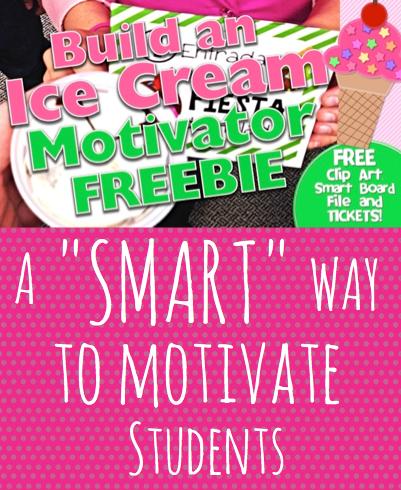
A "Smart" Way to Motivate Students

A "Smart" Way to Motivate Students
Hey, ya'll! My name is Tabitha Carro of FlapJack Educational Resources, and I am more than stoked to be here at Laura Candler's blog, guest-posting for her. A very huge thanks, Laura!

My motto is "Have fun, the learning will come!" So, I wanted to share with you a fun way I motivate my students to reach goals as a class. It's called Build-an-Ice Cream Student Motivator, and I created it to use on the Smartboard. This is a great strategy, especially if students need something fresh and new to motivate them (and sweet!). If you don't have a Smartboard, I'll explain how you can adapt the idea.

Basically, once all students have reached a certain goal of five objective (whatever you decide - math facts, reading log, behavior, etc.), they get to have an ice cream celebration! What's more fun than that??

To explain it to you, I've made a YouTube video that shows exactly how it works. Just click here or on the image below.

http://youtu.be/hqPP1-yVe8k

After watching the video, be sure to pick up all your freebie items at my TpT store! They include:

SMART Board Build-an-Ice Cream File

Ice Cream Party Tickets in English and Spanish

And Ice Cream Clip Art for you to use whenever and however!


If you don't have a Smartboard, I have a solution for you. If you've read Laura's Book Mastering Facts Multiplication and Division, this activity can go right along with her ice cream celebration for learning math facts. So if you don't have an interactive whiteboard in your classroom, you can use a combination of my system and the one that Laura shares in her book. Hope you enjoy using this with your students! Thanks so much!

Tabitha Carro
http://www.flapjackeducation.com/

Tabitha Carro is the creator of the Flapjack Educational Resources blog where she loves to share ways to make learning fun. She started her teaching career in the kindergarten classroom and is currently teaching in SC as a Spanish partial-immersion math and science 4th grade teacher. Tabitha enjoys creating videos for teachers; follow her on YouTube to be sure you don't miss a single one!

March 14, 2014

Make Test Prep Meaningful!

Make Test Prep Meaningful With Student-Created Quizzes
Guest blog post by Blair Turner

They say that nothing is certain in life except death and taxes. But for most educators, there exists one other prominent certainty: standardized testing. It's probably unlikely that a passion for standardized testing is what inspired you to be a teacher, but be that as it may, it's a fact of life.

I firmly believe that fabulous instruction within a safe and supportive classroom community is the best "test prep" strategy out there. That being said, it is important to spend some time preparing students for the structure of a standardized test. Today, I'm going to share one way that I accomplished that in my third grade classroom.

In the weeks leading up to ELA testing, I had students create their own multiple-choice quizzes to accompany a reading selection. I like this activity for a few reasons:

1. It gives students the opportunity to "think like a test creator". 
By having students create their own quizzes, they are forced to think like a test creator. They gain a better understanding of the structure of a multiple-choice question. I encourage them to use test-specific language such as, "according to the text..." and "all of the following are true except...". We discuss the types of answer choices that they can provide. Test creators are known for crafting answer choices that act as "distractors". Wrong answer choices are designed to be tricky, requiring the student to really look back at the selection and determine which information is most relevant to the question. After repeating this activity several times, I find that students get to be EXCELLENT at creating distractors.


2. It is student-centered and student-driven.
There are only so many practice tests you can reasonably ask an elementary student to sit through. By giving students the opportunity to create their own quizzes, they are more engaged and have greater ownership over the task  I usually do this activity in partnerships or small groups so that students can benefit from each other's specific strengths.


3. There is a built-in audience and purpose.
Having students create their own quizzes sets a strong purpose for their reading. They are encouraged to read closely to understand the main idea and to search within the text for details. After their quizzes are complete, I have the students exchange with another group and take each other's quizzes. Since students know their audience, they are more engaged in creating strong questions and answer choices. As you can see in the example pictures, I do not edit the quizzes for content or spelling. I pass this responsibility on to the students themselves. After taking another group's quiz, I ask students to provide the other group with feedback on their work. Which questions were the strongest? Which were unclear? Did any questions have multiple correct answers? This provides another layer of accountability for each group.


I wish you the best of luck as you prepare your students for success on this year's standardized testing!


Blair Turner is a math teacher in grades 1-4. Prior to this position, Blair was a third grade classroom teacher. She enjoys creating and sharing resources for elementary school educators on her blog, One Lesson at aTime. 

March 9, 2014

Tips for Using Camp Chairs in the Classroom

Welcome to the Bright Ideas Blog Hop! I'm teaming up with the bloggers at the bottom of this post to share bright ideas for the classroom. My teaching tip is super simple, but sometimes the simplest ideas make the best solutions!

Who likes to sit in a hard chair all day? I know I don't, and my students never did either. Classroom carpets are nice, but there's never enough room on the carpet for everyone. Bean bags are fun, but they often split and leave the room littered with little white styrofoam pellets! Camp chairs to the rescue!

Camp chairs are perfect for school, both inside and outside the classroom. They're great for those times when students want to move away from their desks to find a comfy spot to read alone or work with others.


Seven Reasons to Use Camp Chairs in the Classroom
  1. Camp chairs are light and portable, easy for kids to grab and move. 
  2. They fold up small enough that four or five of chairs can be stored in a corner of the room. 
  3. Students can take them just about anywhere, making great use of all the little nooks and crannies in your classroom. 
  4. Camp chairs make it easy to circle up for discussion groups and classroom book clubs. 
  5. When students are reading alone, they can turn their chairs to face an empty wall to remove visual distractions.
  6. Students can take camp chairs outside to to get comfy when writing or working out of doors.
  7. Teachers can use them when they need to pull up a chair for a private reading conference with one student. 

How to Get Camp Chairs for Your Classroom: 
  • Parent Donations - Put them on your school supply wish list for the classroom. They are quite inexpensive, especially at the end of the summer when school starts back, so parents will often donate them if you ask. 
  • DonorsChoose Grants - Write a DonorsChoose project proposal to obtain creative seating alternatives for your classroom. and include camp chairs as one option. 
  • Sporting Events and Concerts - If you live near an outdoor venue for sporting events or concerts, check with the management to see if you can have any chairs that are left behind after these events. I've been told that people frequently walk off and leave their chairs behind, and those chairs are given to anyone who wants them. 
  • Yard Sales and Flea Markets - Visit yard sales and flea markets to find bargains on camp chairs.
Ways to Use Camp Chairs 


What are some creative seating solutions you use in your classroom? 

I'm excited to be a part of the giant Bright Ideas Blog Hop! The next blogger is Rachel Lamb, The Tattooed Teacher. She's sharing some tips for using dry erase markers on desks. Click the image below which will take you to here blog! You can also use the links at the bottom of this post to find topics that interest you and hop directly to those blogs. 
The Tattooed Teacher