Showing posts with label Laura's Freebies. Show all posts

December 27, 2015

The Mystery of the Missing Freebies

Are you wondering what happened to all the freebies in Laura Candler's TpT store? Read this post to solve the mystery of the missing freebies!
Imagine this scenario. You're sitting down to plan your lessons for the week, and you remember a freebie you saw in my TpT store that would fit perfectly with your plans. You click over to my store and do a quick search. It's not there. Hmm. You try a different search term. Still no freebie. Then you notice that most of my freebies are gone from my store! Yikes! What happened to all of Laura's freebies???

Fortunately, this mystery is easy to solve. If you've been following me for a few years, you can guess where my freebies are... right back on Teaching Resources which is where most of them were located originally. You'll be happy to learn that everything is still free, too! The big question is how to find those freebies now.

If you want to know the backstory behind the change, keep reading. If you just want to know the fastest way to get to all those freebies, skip this section and jump to the tips for finding them!

The Backstory...
What happened was that last week I took a serious look at my TpT store and realized that it was a hot mess! The product covers did not have a consistent look, and some of them were downright difficult to read in thumbnail form. So I tackled the project of updating my cover images, organizing the categories in the sidebar, and cleaning up my store. Sort of like a spring cleaning about 3 months early! I'm not finished, but here's a peek at how the first few pages of my TpT store look and the rest will be updated soon.


After working for several hours, I realized that I had a TpT freebie problem. Would you believe I had over 80 freebies in my store?! Frankly, there were so many freebies there that it was becoming overwhelming to manage them all. Most of those freebies were still on my Teaching Resources site, too, although many of the ones on my site had not been updated in a long time. The problem was that every time I updated a freebie, I had to update it on my website and in my TpT store, which meant creating all new thumbnail images for TpT and updating the descriptions. Honestly, I just wasn't able to keep up with it all.

To simplify things, I decided to deactivate most of the freebies in my TpT store and host them in one place - on Teaching Resources. The next time I revise a freebie, I'll only have to update the file on my website, and all of the links and images throughout the site will automatically update.

Tips for Finding My Freebies 

So where can you find all the freebies that used to be in my store? Many of them are in my online File Cabinet or on the Teaching Strategies pages. You can also use the green search tool at the top of Teaching Resources, right under the navigation bar to try to find what you need.

Sign up for Candler's Classroom Connections to gain access to a page with DOZENS of Laura Candler's best freebies!
But wouldn't it be nice if you didn't have to search all over Teaching Resources for them, and the best freebies were listed on one page?

Great minds think alike! I had the same thought, so I created a special page that has a long, clickable list with DOZENS of my freebies that used to be on TpT.

To access this page of my very best freebies, subscribe to Candler's Classroom Connectionsand then follow the links in the Welcome email.

If you're already on my mailing list, check your inbox and find the message I sent on December 27th with links to the new Subscriber Resources page and the page titled Laura's Best Freebies.

If you can't find it, sign up for the newsletter again. If you use the same email address you used before, you'll be asked to update your profile. After you fill out the form and click Update Profile, check your inbox for an email with links to the free resources for subscribers. If you don't receive that email, you'll need to sign up with a different email address.

Looks like the case of the missing freebies has been solved, so I'm officially closing the books on this one!


January 24, 2013

February Freebies Galore!

Check out the February Freebies link up for free seasonal teaching resources!
February is such a fun month in elementary school, even in the upper elementary grades. You can do all sorts of activities with the holidays in February as well as create fun winter lessons. Learning doesn't have to be sacrificed in the name of fun, either, as you'll soon discover! Over the last few years, I've created loads of free resources for February that I'd like to share with you now.

You can find all of these freebies and more on my Seasonal Activities page during the month of February or my Laura's Best Freebies page all year round.

February Activities Mini Pack
This 25-page packet offers ready-to-use lessons and activities for February that foster higher level thinking while motivating students. Activities include math word problems, a candy heart fraction lesson, a friendship poetry activity, a word challenge, and directions for writing a President or Black History biography. The February Activities Mini Pack is offered for free as a sample of my Seasonal Activities Bundle. It's free for subscribers of Candler's Classroom Connections; click here to sign up for your free copy.


Chinese New Year Literacy Activities freebie - includes sorting activity and discussion cards.
Chinese New Year Activities
The Chinese New Year takes place in January during some years and in February during others. No matter when it occurs, you'll love these two literacy activities to use during this special event. Both were designed to be completed by kids working in cooperative learning teams, but they would work equally well with partners. The first lesson is a sorting activity in which cards with facts about the Chinese and American New Years are placed on a Venn diagram. The second involves discussion cards to use with Sam and the Lucky Money. Download this freebie from my Seasonal Activities page on Teaching Resources during January and February, or from my Laura's Best Freebies page any time of the year.


Black History Character Bios
During February, many classrooms celebrate Black History month. Students often research famous African Americans and write a report or share the information in some way. Unfortunately, many students don't know how to research, organize, and write a report and do far too much copying and pasting. The Character Trait Bio activity is a little different from the normal writing assignment because students are asked to organize their essays around character traits which makes plagiarism almost impossible. This is activity is a sample from my Character Bio Reports Mini Pack.


You can download any of these freebies from my from my Seasonal Activities page on Teaching Resources during February, or from my Laura's Best Freebies page any time of the year. I hope your students enjoy these engaging activities and learn a little something along the way!

October 10, 2012

Weathering, Erosion, or Deposition? Sorting Out the Processes


Science is one of my favorite subjects, and I've always been interested in geology and landforms. I remember hiking through the White Mountains of New Hampshire as a child, listening to my father explain the geology of the area. He showed me evidence of glaciers that once covered the area, interesting caves and rock formations, and fossils of sea animals that somehow ended up high in the mountains! I still enjoy hiking and other outdoor activities, and I often wonder how certain features of the earth were formed.

I guess those early experiences are why I enjoy teaching students about landforms of the Earth. Hands-on activities and opportunities to explore nature are especially important in this area of study. One of my favorite projects is to have students work in teams to create islands from salt dough, and each island has to include specific landforms. When students share about their islands with the class, they have to explain how those landforms might have been formed. We read books about weathering, erosion, and deposition, and even take walks outside to observe evidence of these three processes in nature. I show photos of pictures I have taken myself and other pictures I've found on the internet to explain how weathering, erosion, and deposition shaped Earth's surface.

Sorting Out the Processes (and a Freebie!)
Yet even with all of those activities, my students still had trouble remembering the difference between weathering, erosion, and deposition. These concepts are very confusing. To help them practice, I created a sorting activity with examples that students could read and classify into one of the three categories.

They worked in teams because having time to discuss and debate the placement of the cards was really helpful as they grappled with the concepts. When they discussed a card, they had to talk over the action taking place and decide if it was most likely weathering, erosion, or deposition. They took turns so all students had the opportunity to participate equally.

If you'd like to use this sorting activity with your students, you can download it for free from my TeachersPayTeachers store.

Illustrated Task Cards and Self-Grading Google Quizzes
If you believe that a picture is worth 1000 words, you'll love my resource for teaching this topic. Weathering, Erosion, and Deposition Task Cards and Google Quizzes includes 24 printable task cards in both black & white and color, as well as 24 task card images that can be used with the free Plickers program or with Google Classroom. You can even use the images to create digital decks of task cards for cooperative learning activities like Showdown! Weathering, Erosion, and Deposition also includes two self-grading Google quizzes that can be assigned with Google Classroom or administered as online formative assessments. 


The illustrations on these Weathering, Erosion, and Deposition task cards are what make them really unique. Most of drawings were created by my daughter Wendy Candler of Digital Classroom Clipart on TpT, and I love the simplicity of her artwork. Somehow Wendy was able to capture the essence of how weathering, erosion, or deposition contributed to each situation being depicted without adding unnecessary details.

I hope these activities and resources help your students develop a deeper understanding of the difference between weathering, erosion, and deposition.


September 15, 2012

Making the Social Studies and Literacy Connection

Making the Social Studies and Literacy Connection - Two great informational texts and two freebies to use on Constitution Day!
Free Resources for Constitution Day

September 17th is Constitution Day, and it’s a great time to integrate social studies into your literacy lessons. I discovered two outstanding informational text books to read and discuss with your students, and I couldn’t resist creating some freebies to go with them! Both books are perfect for upper elementary students, and if you only have one copy of each book, you can read it aloud and show the pages so your students can follow along. If you don’t have these books now, you can click the book covers below to order them from Amazon.com. Then use the activities later in the year when you are studying the US government or the Constitution. You'll find these freebies in my Constitution Day freebie on TpT during September and on my Social Studies page on Teaching Resources all year round.


What's the Truth? (Sorting Activity)

Author: Christine Taylor-Butler

The Constitution of the United States is a part of the Scholastic "True Book" series, and it's an excellent informational text for upper elementary students. What's the Truth? is a hands-on sorting activity to stimulate thinking before you read the book to your students. Print one set of cards per team, and ask team members to cut the cards apart and stack them in the middle of the team.

Here's what to do:
  1. Before you read the book, ask students in teams to take turns picking up a card, reading it aloud, and discussing whether or not they think the statement is true or false. 
  2. As they decide if each statement is true or false, the card is placed into one of two piles accordingly. 
  3. Optional: Have team members write a T or an F on the back of each card for future reference. 
  4. As you read the book, stop from time to time and ask your students to discuss what you've read so far. If you mentioned a concept that was on one of the cards, they may check to see if they classified it correctly. 
  5. After you finish reading the book, review all the statements to be sure everyone has the correct answers. 

Constitution Discussion Questions

Title: If You Were There When They Signed the Constitution 
Author: Elizabeth Levy

If You Were There When They Signed the Constitution is a longer book and will take several days to read. I've created a set of Constitution Discussion Questions that you can use when you finish reading the book or where appropriate during the book. Because the questions are quite challenging, I suggest using the Talking Sticks discussion strategy in small guided reading groups or as a whole class.

The book is most appropriate for upper elementary students, but you may be able to use it with middle school students as well. You’ll need to preview the book to decide. The discussion questions are fairly generic and can be used with any in-depth discussion or study of the Constitution. After you’ve discussed all of them as a class, you may want to have your students choose one to write about in a journal entry.

Where to Find These Free Resources

These sorting cards and discussion cards are available for free in several places. During the month of September, you can download them from my TpT when you click over to my free Constitution Day Literacy Lessons. You can also find them on the Social Studies page on Teaching Resources. Additional activities on that page include a Branches of Government sorting activity, a cooperative learning lesson to learn the meaning of the Preamble, and a printable you can use to create your own Classroom Bill of Rights. 

With limited time in the elementary school day, it's important to be able to sneak in a little social studies with your literacy lessons. These activities can be used on Constitution Day or any time when your class is studying U.S. Government or the Constitution. What are some ways that you connect social studies and literature in your classroom?

September 10, 2012

Honoring 9/11 - A Delicate Balance


September 11th is a day when many of us will reflect on a series of events that made a lasting impression on our lives. If you are like many teachers, you may be struggling with whether or not you should discuss 9/11 with your students. Even though this event happened before your students were born, you may feel a need to  recognize the events of that significant day. Last year I discovered a great book to read aloud on September 11th, The Man Who Walked Between the Towers. I'd like to share a few ideas for using this book in your classroom.

Read aloud the The Man Who Walked Between the Towers, the amazing true story of Philippe Petit who walked on a high wire between the two towers right after they were constructed. The story focuses on his daring feat and simply mentions at the end that the towers are gone and only live on in our memories. Be ready for the question that is sure to arise, "What happened to the towers?" How you answer that will depend on your students' ages and what you feel is appropriate to share.

Discuss the The Man Who Walked Between the Towers
You can use this set of question cards I created for the book to discuss it with your students. These questions would work will with the Talking Stick discussion method, but because of the sensitive nature of the topic, I suggest discussing these questions as a whole class or in small guided reading groups rather than in cooperative learning groups. These questions deal specifically with Philippe Petit's daring feat and do not deal with the events of 9/11.


Compare and Contrast Literature and Informational Text
Start by reading The Man Who Walked Between the Towers aloud and telling your students that it's based on a true event. Ask them to help you create a list of questions about the event that include additional information they wonder about what happened. Then ask them to read a news account or an encyclopedia article about Petit's walk between the towers. I found a description of his walk in an article about Petit on Wikipedia.org, and I edited it to create a shorter PDF version to use with students. Please remember that this is intended for use with during a reading activity, and the details in the Wikipedia article may not be 100% accurate. As a class, create a Venn diagram or other graphic organizer to compare and contrast the two versions of the event. What was left out in the story? Why did the author leave out these details? Are any of the details different between the two versions?

Explore Numbers and Measurements
The Man Who Walked Between the Towers includes many references to lengths, heights, and widths. I created a page of task cards showing those amounts that you can use with your students. After reading and discussing the story, show all 8 cards to your students and ask them to try to remember what each amount referred to in the story. You could even give each team or pair one set of cards and have the students write that information on the back of each card. For example, on the back of the "Quarter of a mile" card, they might write "height of the towers." After they work through the deck and make their guesses from memory, reread the story aloud to check and discuss answers.

Experiment with center of gravity
One thing that amazes me about this story is the way Petit can be so confident about his ability to walk across the wire without falling. The story does not get into the scientific aspects of how he's able to do this, but it has to do with that 28-foot balance pole he carries. This is a perfect opportunity to have your students explore center of gravity concepts. Rachel Lynette's book Gravity: Forces and Motion has some excellent discovery activities for this concept. One of them involves trying to balance an orange on a pencil, which is nearly impossible, and then adding forks to the sides as shown. Add a lump of modeling clay to each fork handle, and you can balance the orange easily. The lumps of clay move the center of gravity to a point lower than the orange, allowing it to balance. You can find a more complete explanation in this book or other science books about force and motion. 

Discuss Events of 9/11
I realize that none of these suggestions deals with the events of 9/11. If you want to talk to your students about what happened on that day, I would suggest starting with the free BrainPOP video titled September 11th. I showed it to my 5th graders, and it was very really helpful as a foundation for a discussion about what happened. The 6-minute video explains why these events occurred without going into unnecessary detail. Be sure you watch the video yourself before showing it to your students so you'll know how to answer their questions.

September 11th will be a difficult day for many of us. We remember that day with sadness, and also with an awareness of how quickly our lives can change. It was a day when we discovered that our sense of security about our own lives can evaporate in a flash. However, I don't believe we should allow our feelings about those events to negatively impact our children. Children need to feel a sense of security in order to grow and thrive, and we should be mindful of this tomorrow. That's one reason I love the book, The Man Who Walked Between the Towers. Reading this story to our students allows us to honor the memory of the day the twin towers went down in a gentle way without instilling a sense of fear and insecurity in our children.


September 5, 2012

Tips for Teaching Informational Text


About the only thing we can count on in education is that something is always changing! Our society changes, technology changes, our students are changing, and as a result, the curriculum is constantly evolving. Change can be exciting, but often it’s frustrating as well. This is especially true when it comes to the Common Core Reading Standards and the new emphasis on informational text. Fortunately, I had the opportunity to explore this aspect of the CCSS while writing Graphic Organizers for Reading: Teaching Tools Aligned with the Common Core. Now I’d like to share some of those tips and strategies for teaching informational text with you.

Comparing and Contrasting Text Types
One of the best ways to get started is to have your students compare informational text with literature. Sounds like the perfect time for a Venn diagram, doesn’t it?  Show your students several examples of both types of books, and ask them to help you brainstorm how those text types are alike and different. Record their ideas on a class Venn diagram. If you have a document camera, use it to display the pages of the book so that everyone can see all of the features on each page clearly. If you don’t have a document camera, ask the students at the back of the room to move closer and have a seat on the floor near you.

Choosing the Right Informational Text
Most students are very familiar with fiction, but they may not be nearly as familiar with nonfiction. That’s why it’s important to select just the right informational text to use for this lesson, something that includes a variety of nonfiction text features. Last year I discovered the perfect book for this activity. Did you know that Rachel Lynette of the Minds in Bloom blog is the author of over 70 nonfiction books for kids? In fact, she has a nice Informational Text Structures freebie that you'll want to check out. Rachel sent me a copy of Gravity: Forces and Motion, and it turned out to be just what I needed as an anchor text for my Informational Text Features Search lesson. If force and motion are not a part of your curriculum, take a look at Rachel Lynette's other nonfiction books on Amazon.com. I'm sure you'll find something that fits in with what you are teaching now or will be teaching later in the year.

When you display a nonfiction book like Gravity: Forces and Motion, your students will see at a glance that informational texts look quite different from literary ones. Within a few minutes, they will identify many details to add to your class Venn diagram. As you can see from this snapshot of Rachel’s book, informational text elements often include numbered steps, headings and subheadings, illustrations with captions, and so on. Explain to your students that these items are referred to as “text features,” and the author includes them to help make the text easier to understand. As you discuss each feature, ask your students how it helps them to comprehend, or understand, the text.

Informational Text Features Search Freebie
After your students become aware that informational texts are different from literary ones, they can apply their knowledge to text of their own choosing. Because I included this lesson in Graphic Organizers for Reading, the easiest way for me to share it with you is to give you the directions and graphic organizer as a freebie. Click the image or this link to download your copy. Before teaching the lesson, gather a collection of books on a variety of topics that include many different informational text features. If you don’t have enough of these types of texts in the classroom, it’s worth a visit to the school library to hand pick books on a variety of topics and reading levels. Or you can schedule a class visit to the library and ask your students to find informational books on topics that interest them.

Combo Book Giveaway
Last year when Rachel sent me her book, Gravity: Forces and Motion, she also sent me a second autographed copy to pass along to one of my followers in a giveaway. Since she generously donated one of her books, I’ve decided to donate one of mine, too. These two books are a natural combination because Gravity is actually one of the recommended texts in Graphic Organizers for Reading: Teaching Tools Aligned with the Common Core. Even if you don’t teach science, you can use Rachel’s book in conjunction with the lessons in my book to help your students become more comfortable with reading informational text. Before you know it, your students will discover that nonfiction books can open doors to worlds they never knew existed!


Note: The giveaway end at 9 p.m. EST on September 10th. I'll be selecting and notifying the winner soon. 


May 9, 2012

Green Court Claims Freebie

Common Core Aligned for Reading Informational Text and all Speaking & Listening Standards

About a month ago, I shared a special activity I developed for Earth Day called Green Court Claims. You can read my blog post, "Green Companies? Let the Jury Decide!" for a full explanation of the activity. For now, I'll just share that students investigate companies' claims that their products are "green" or earth-friendly. Students research the facts behind the claim, discuss the arguments on both sides, and present those claims to their classmates. Their classmates become the jury and decide whether those claims are valid in order to reach a verdict. You'll find everything you need in this free lesson packet on my Science page on Teaching Resources. You'll find the Common Core Alignment details at the back of the packet.

The first time I shared Green Court Claims, it was completely untested in the classroom. The only reason I shared it without testing it was because Earth Day was fast approaching and I felt it would be a perfect activity for that special day. So I asked a few bloggers to test out the lesson with their students, and Mandy Neal of Teaching with Simplicity immediately offered to try it with her 4th grade class. I was excited to learn that her class loved it, and that she felt it was a really worthwhile experience for them. You can read about their green claim investigations in her blog post, "You Be the Judge."  After I was assured that everything worked out as planned, I compiled all the directions and student printables in one packet to share with you.

You'll find this activity along with loads of other free materials on my Teaching Resources Science page. Even if you don't teach science, I think this lesson would make a terrific class activity for a study of propaganda, or an excellent jumping-off point for a lesson on writing persuasive essays. If you use the lesson, I'd love for you to return and leave a comment to share how it worked for you. What "green" claims have you read or seen recently that you suspect are not particularly friendly to the environment? When you start looking for them, they are easy to find!


Laura Candler
Teaching Resources

April 30, 2012

Fun Twist on Book Reports!


Five Looks on a Book is a simple and fun activity that offers a nice twist on the traditional book report. Students name five adjectives that describe their book and then write one supporting detail for each adjective. You can download this freebie from my Reading Workshop page on Teaching Resources.


The original idea for the activity came from 3rd grader Adrienne Duarte, and I created the graphic organizer to go with her idea. When I first shared this activity online, Facebook fans helped me brainstorm adjectives to describe books. We came up with 99 different adjectives, and Stephanie Schifini compiled and alphabetized the list. Thanks, Adrienne and Stephanie!

If you use this activity with students, I would recommend having students brainstorm adjectives for books before showing them your list of 99 adjectives. In fact, why not make it a challenge? Tell them that you have a list of 99 adjectives and you want to see if they can come up with a list of 99 adjectives without looking at your list!  

Post a large sheet of paper on a bulletin board and allow students to add adjectives throughout the week. When they have found as many as possible, reveal your words and compare the two lists. After students complete their worksheets, arrange them on the bulletin board around the poster. Title the board, "Take A Look!" and you've just created an instant bulletin board display!

Five Looks on a Book is such a quick and easy activity that you could easily repeat it several times throughout the year, or even once a month. You can download this 3-page freebie from my Reading Workshop page on Teaching Resources. Give it a try, and let me know what you think!

April 18, 2012

Crazy Class Auctions and a Freebie!

April is Financial Literacy Month, so it's a perfect time to introduce a classroom economy system. This program makes a great reward system and teaches students how to manage money. Several years ago I created this free Classroom Economy Pack, and I recently updated it with a new cover and new images to give it a fresh look.

You may have also seen it on Pinterest as the "Classroom Money Pack," a version I created because you don't have to use the materials to set up a complete classroom economy system. You can use the money patterns and bank transaction record any way you like. Download this freebie from my TeachersPayTeachers store.

Class Auctions
One of my favorite parts of my own Classroom Economy program was my Class Auction. I paid students for their class jobs with classroom money, and at the end of each quarter, the students brought in items from home to auction off. Here you can see them gathered around our carpet area where we would spread out all of the items to auction off. At first I was the auctioneer, but then my students would take turns in that role. Those auctions were crazy and fun, and everyone walked away with a little something!


In the Classroom Economy Pack freebie, I included this idea and many more for setting up your own program. What are some of your favorite strategies to use with classroom money and for teaching financial literacy?

You can download the Classroom Economy Pack from my TeachersPayTeachers store. Please leave a comment to tell me how you use classroom money with your students!

April 17, 2012

Just a Dream to Save Our Planet

Just a Dream to Save Our Planet
A few weeks ago I posted a question on Facebook asking teachers to tell me their favorite book to read aloud for Earth Day. Just a Dream by Chris Van Allsburg was the top recommendation, but I had not read it before. I always like his books, so I immediately ordered it from Amazon.com. It's a beautiful picture book about a boy named Walter who imagines an exciting future on Earth - until he has a dream with a series of episodes that take him on an unforgettable adventure. Walter sees what will happen to the Earth if we don't take better care of our planet.

What a great introduction to environmental issues and problems! Thanks to everyone who recommended it. It was written in 1990 so I'm not quite sure how I missed this treasure!

I had so much fun creating a set of activities based on the theme of this book!  Just a Dream to Save Our Planet starts with a quick Think-Pair-Share for students to discuss their visions of the future and is followed by a read-aloud session. After that, you can choose from several cooperative learning and writing activities.


You can download this free packet to go with Just a Dream from my TeachersPayTeachers store. Everything is explained in the teacher directions, but here's a quick list of what you'll find:
  • 8 prepared discussion cards
  • 4 blank discussion cards
  • 9 cards describing the events
  • A graphic organizer for sorting the event cards into categories
  • Problem-Solution graphic organizers for the environmental issues   
Why am I giving this 15-page packet away for free? I guess because I think it's so important for all kids to explore environmental issues and discuss ways to protect our Earth. So it's my gift to you, and I hope you will make this lesson your gift to your students!

April 10, 2012

Save Time and Paper with Mini ABC Books!

Free Mini ABC Booklets - perfect for so many different types of projects!
Have you ever had your students do an ABC booklet as a project? One way to do this is to ask students to use full sheets of paper and create a separate page for each letter of the alphabet. On each page they include a word, a bit of text, and an illustration related to their topic.

The problem is that it takes forever to complete and it requires over 20 sheets of paper per student! My Mini ABC Book solves both of these problems, and it's free, too! The booklet consists of 4 printable pages that are duplicated front to back on 2 sheets of paper. Fold the pages and staple them in the middle to create a small booklet.

Students complete the pages by writing a sentence for each letter and drawing one illustration per page. Since each half page has 4 alphabet letters but only one place to draw a picture, it takes about 1/4 of the time to complete as a regular ABC booklet.

The booklet shown above can be used for almost any ABC project. Assign topics, or let students choose their own. Make sure the topic is broad enough that your students will be able to think of a keyword or phrase for each letter of the alphabet. In science, you might use this during a study of the the solar system. In social studies, it would work for community helpers or a historical time period. In health, it would work great for a nutrition unit.

Cooperative Learning ABC Projects
How about turning this into a team or partner project? Ask team members to brainstorm ideas together for each letter of the alphabet and then divide up the pages to do the work. However, you won't be able to print the pages front to back; instead, glue them together after students finish their individual pages.


Free Mini ABC Booklets - perfect for so many different types of projects!
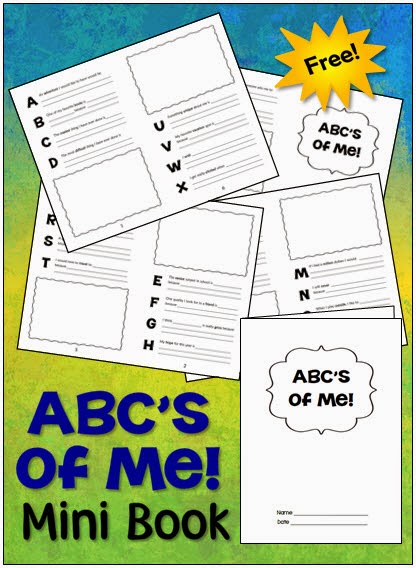
ABC's of Me Booklet
A fun variation of this project is the ABC's of Me booklet. It's a great way for students to get to know each other at the beginning of the year, and it makes a nice end-of-year project, too. Each letter of the alphabet has a sentence starter to help students think of something to wrote. For example, the sentence starter for A is "An adventure I would like to have is ...."

Thanks to Francie Kugelman for the ABC's of Me concept. I designed the booklet, and several teachers on Facebook contributed ideas for sentence starters for each letter of the alphabet, so this was definitely a collaborative effort!

Where to Download These Freebies
Both of these ABC Mini Books can be found on Laura's Best Freebies, a private page on my website that can be accessed by subscribers to my newsletter, Candler's Classroom Connections. If you're a current subscriber, check your recent emails from me to find a link. If you aren't a subscriber, you can sign up for free on Teaching Resources here.

ABC Project Topics Needed
How might you use the ABC Mini Book? Do any topics come to mind? Please share your ideas in a comment below.


April 8, 2012

Boost Class Spirit with Tie-Dyed T-shirts!

Spring is here, and that means field days and field trips! As the weather turns sunny and warm, kids and teachers both want to get out of the classroom. But sometimes after everyone is outside, it's difficult to keep track of your students! That's why I started doing this easy tie-dye t-shirt project early in the spring. As you can see from this photo of my former class on a class trip to the zoo, when everyone is wearing the same color shirt, it's easy to locate them no matter where they are. It's also really helpful for your parent volunteers because they know exactly who's in your class. Therefore, they feel more comfortable speaking to any of your students who are acting a bit rambunctious. 

For years I had thought of doing a tie-dye project with my class, but the whole thing always seemed so messy. I remember walking by classrooms where kids were tying shirts and squirting dye onto them, and the project seemed like way more than I wanted to tackle. 

But one year my entire grade level decided to tie-dye shirts, with each class choosing a different color. They explained that it's easy when you have the kids tie up their shirts at school and you take them home to dye in your washer. Yes, I know! I thought the same thing! Whoa! I'm not putting purple dye into MY washing machine! However, they convinced me to give it a try saying that all it takes to clean the washer later is running a wash cycle with bleach and hot water. I followed their directions and it really was easy! My students loved tying their shirts and creating their own unique designs, and it was terrific to have the shirts ready to go for field day and for our spring field trip.

How to Download the Free Directions
Because I love this project so much and want others to try it, I've written detailed directions explaining exactly what to do. I also included sample parent letters requesting the t-shirts and money for the dye. You can download Tie-Dye T-shirts Made Easy from my Teaching Resources website on the Odds N Ends page.   

Making tie-dyed t-shirts was a great activity for boosting class spirit, and it proved to be an excellent classroom management tool as well - or maybe I should say, an excellent outdoor management tool! I hope your students enjoy the project as much as mine did!