Showing posts with label featured freebies. Show all posts

April 18, 2012

Crazy Class Auctions and a Freebie!

April is Financial Literacy Month, so it's a perfect time to introduce a classroom economy system. This program makes a great reward system and teaches students how to manage money. Several years ago I created this free Classroom Economy Pack, and I recently updated it with a new cover and new images to give it a fresh look.

You may have also seen it on Pinterest as the "Classroom Money Pack," a version I created because you don't have to use the materials to set up a complete classroom economy system. You can use the money patterns and bank transaction record any way you like. Download this freebie from my TeachersPayTeachers store.

Class Auctions
One of my favorite parts of my own Classroom Economy program was my Class Auction. I paid students for their class jobs with classroom money, and at the end of each quarter, the students brought in items from home to auction off. Here you can see them gathered around our carpet area where we would spread out all of the items to auction off. At first I was the auctioneer, but then my students would take turns in that role. Those auctions were crazy and fun, and everyone walked away with a little something!


In the Classroom Economy Pack freebie, I included this idea and many more for setting up your own program. What are some of your favorite strategies to use with classroom money and for teaching financial literacy?

You can download the Classroom Economy Pack from my TeachersPayTeachers store. Please leave a comment to tell me how you use classroom money with your students!

April 17, 2012

Just a Dream to Save Our Planet

Just a Dream to Save Our Planet
A few weeks ago I posted a question on Facebook asking teachers to tell me their favorite book to read aloud for Earth Day. Just a Dream by Chris Van Allsburg was the top recommendation, but I had not read it before. I always like his books, so I immediately ordered it from Amazon.com. It's a beautiful picture book about a boy named Walter who imagines an exciting future on Earth - until he has a dream with a series of episodes that take him on an unforgettable adventure. Walter sees what will happen to the Earth if we don't take better care of our planet.

What a great introduction to environmental issues and problems! Thanks to everyone who recommended it. It was written in 1990 so I'm not quite sure how I missed this treasure!

I had so much fun creating a set of activities based on the theme of this book!  Just a Dream to Save Our Planet starts with a quick Think-Pair-Share for students to discuss their visions of the future and is followed by a read-aloud session. After that, you can choose from several cooperative learning and writing activities.


You can download this free packet to go with Just a Dream from my TeachersPayTeachers store. Everything is explained in the teacher directions, but here's a quick list of what you'll find:
  • 8 prepared discussion cards
  • 4 blank discussion cards
  • 9 cards describing the events
  • A graphic organizer for sorting the event cards into categories
  • Problem-Solution graphic organizers for the environmental issues   
Why am I giving this 15-page packet away for free? I guess because I think it's so important for all kids to explore environmental issues and discuss ways to protect our Earth. So it's my gift to you, and I hope you will make this lesson your gift to your students!

April 10, 2012

Save Time and Paper with Mini ABC Books!

Free Mini ABC Booklets - perfect for so many different types of projects!
Have you ever had your students do an ABC booklet as a project? One way to do this is to ask students to use full sheets of paper and create a separate page for each letter of the alphabet. On each page they include a word, a bit of text, and an illustration related to their topic.

The problem is that it takes forever to complete and it requires over 20 sheets of paper per student! My Mini ABC Book solves both of these problems, and it's free, too! The booklet consists of 4 printable pages that are duplicated front to back on 2 sheets of paper. Fold the pages and staple them in the middle to create a small booklet.

Students complete the pages by writing a sentence for each letter and drawing one illustration per page. Since each half page has 4 alphabet letters but only one place to draw a picture, it takes about 1/4 of the time to complete as a regular ABC booklet.

The booklet shown above can be used for almost any ABC project. Assign topics, or let students choose their own. Make sure the topic is broad enough that your students will be able to think of a keyword or phrase for each letter of the alphabet. In science, you might use this during a study of the the solar system. In social studies, it would work for community helpers or a historical time period. In health, it would work great for a nutrition unit.

Cooperative Learning ABC Projects
How about turning this into a team or partner project? Ask team members to brainstorm ideas together for each letter of the alphabet and then divide up the pages to do the work. However, you won't be able to print the pages front to back; instead, glue them together after students finish their individual pages.


Free Mini ABC Booklets - perfect for so many different types of projects!
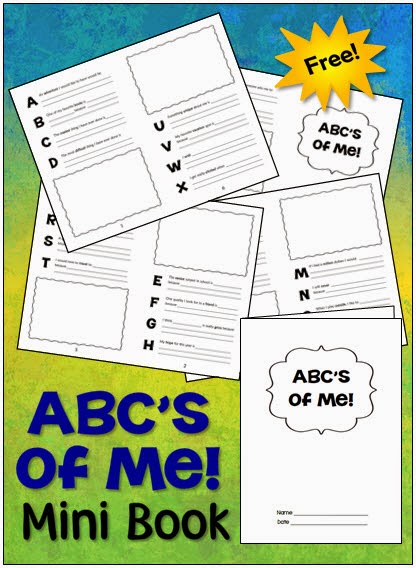
ABC's of Me Booklet
A fun variation of this project is the ABC's of Me booklet. It's a great way for students to get to know each other at the beginning of the year, and it makes a nice end-of-year project, too. Each letter of the alphabet has a sentence starter to help students think of something to wrote. For example, the sentence starter for A is "An adventure I would like to have is ...."

Thanks to Francie Kugelman for the ABC's of Me concept. I designed the booklet, and several teachers on Facebook contributed ideas for sentence starters for each letter of the alphabet, so this was definitely a collaborative effort!

Where to Download These Freebies
Both of these ABC Mini Books can be found on Laura's Best Freebies, a private page on my website that can be accessed by subscribers to my newsletter, Candler's Classroom Connections. If you're a current subscriber, check your recent emails from me to find a link. If you aren't a subscriber, you can sign up for free on Teaching Resources here.

ABC Project Topics Needed
How might you use the ABC Mini Book? Do any topics come to mind? Please share your ideas in a comment below.


April 8, 2012

Boost Class Spirit with Tie-Dyed T-shirts!

Spring is here, and that means field days and field trips! As the weather turns sunny and warm, kids and teachers both want to get out of the classroom. But sometimes after everyone is outside, it's difficult to keep track of your students! That's why I started doing this easy tie-dye t-shirt project early in the spring. As you can see from this photo of my former class on a class trip to the zoo, when everyone is wearing the same color shirt, it's easy to locate them no matter where they are. It's also really helpful for your parent volunteers because they know exactly who's in your class. Therefore, they feel more comfortable speaking to any of your students who are acting a bit rambunctious. 

For years I had thought of doing a tie-dye project with my class, but the whole thing always seemed so messy. I remember walking by classrooms where kids were tying shirts and squirting dye onto them, and the project seemed like way more than I wanted to tackle. 

But one year my entire grade level decided to tie-dye shirts, with each class choosing a different color. They explained that it's easy when you have the kids tie up their shirts at school and you take them home to dye in your washer. Yes, I know! I thought the same thing! Whoa! I'm not putting purple dye into MY washing machine! However, they convinced me to give it a try saying that all it takes to clean the washer later is running a wash cycle with bleach and hot water. I followed their directions and it really was easy! My students loved tying their shirts and creating their own unique designs, and it was terrific to have the shirts ready to go for field day and for our spring field trip.


How to Download the Free Directions
Because I love this project so much and want others to try it, I've written detailed directions explaining exactly what to do. I also included sample parent letters requesting the t-shirts and money for the dye. You can download Tie-Dye T-shirts Made Easy from my Teaching Resources website on the Odds N Ends page.   

Making tie-dyed t-shirts was a great activity for boosting class spirit, and it proved to be an excellent classroom management tool as well - or maybe I should say, an excellent outdoor management tool! I hope your students enjoy the project as much as mine did!

April 7, 2012

Try This When Kids Are Absent!

Doesn't it drive you crazy when kids are absent for several days and you have to gather up a list of assignments they need to complete? Even though I know it's usually not their fault for being absent, it's one more management task to add to my already full load. Let's not even mention the times I've had to do this for students whose families take trips to Disney World in the middle of the school year!

I developed this assignment make up form to make my job a little easier when kids are absent. You can download it from the
Classroom Management page on Teaching Resources. Here's how I used it:


  1. Each day that a student was absent, I placed this form on his or her desk. 
  2. I assigned a student in the same team to write down any classwork or homework assignments on the chart at the bottom. 
  3. If I handed out a graphic organizer or worksheet to complete, I asked the student helper to paperclip it to the back of this form and write the title of the assignment on the front. 
  4. When the absent student returned, he or she was given the packet of make-up work which included due dates. 
  5. As each assignment was turned in, I checked it off and initialed that it was completed. I kept the final form for my own records.
  6. If a student was particularly forgetful or irresponsible, I made a copy of this form before giving it to the child. In the event that the make-up work was not turned in on time, this form was my proof to the parent that I did provide the child with a list of assignments to complete.
  7. If students were absent more than one day, I completed prepared a separate form for each day. In fact, I just kept a stack of these forms in my paper organizer because someone was absent almost every day. 
This system worked great for me because it was an easy way to make sure that I didn't accidentally overlook an assignment. It also helps to keep the student organized and parents love it. If a student does not complete the make-up work, they can't claim that I never told them about it because the proof is right on the form! 

What is your favorite system for making sure students complete work after they are absent?


March 26, 2012

Easter Egg Showdown Review


Easter egg activities aren't just for little ones! You might not take older kids on an Easter egg hunt, but you can bring colorful plastic eggs into the classroom and jazz up any review activity using this Easter Egg Showdown freebie!

Showdown is a cooperative learning activity in which students work first alone, and then with a team, to solve problems or answer questions on task cards. Easter Egg Showdown is a variation in which the task cards are tucked inside plastic Easter eggs. Students select an egg, open it, read the problem or task, and everyone on the team writes a response. In the final step, team members compare and discuss their answers. In this example, the task cards contain sentences, and students have to identify the subject and the predicate of each sentence.

Easter Egg Showdown Freebie
The Easter Egg Showdown packet includes teacher directions, student directions, the Subject and Predicate activity shown in the photo, Division Showdown task cards, and blank templates to create your own. You can download it from my TpT Store or from the Seasonal page on Teaching Resources. Feedback is always appreciated!
One reason I love this activity is that you can easily adapt almost any Showdown lesson to use with the Easter Eggs. To find more Showdown activities, visit my TpT store and type "showdown" into the search box. Showdown works well with basic math review problems, vocabulary words and definitions, states and capitals, or science and social studies questions. What an "eggsciting" way to review!


March 23, 2012

Island Conquer Area & Perimeter Games

Area and perimeter are two concepts that students frequently confuse, so fun math games to practice those skills are always welcome - especially when they are free! Island Conquer is a set of two games that provide opportunities for students to explore area or perimeter on a coordinate grid. Students play with a partner and take turns using the Coordinate Cards to plot rectangles on the Island Conquer game board. After each person plots a rectangle, he or she calculates the area or perimeter of the "captured" island. At the end of the game, they add up the total area or perimeter to find out who is the new Island King or Queen!

You can download this freebie from the Geometry folder in my online Math File Cabinet at Teaching Resources. I hope your students enjoy this game as much as mine did!


March 5, 2012

Leprechaun Luck Probability Freebie

Looking for a fun way to teach probability? You're in luck! The Leprechaun Luck Game is a freebie that allows kids to explore probability in an exciting game of chance. In order to win, your students will need a bit of luck, but they'll also discover that there's more than luck involved in winning.

You’ll need a box of Lucky Charms cereal for the class and one Leprechaun Luck game board for each student. You'll also need two dice for each game. Download the free instructions and the game boards from my TpT Store. Pair students with a partner of similar abilities, and display the directions as you explain the rules.


How to Play Leprechaun Luck
  1. Each player places 12 Lucky Charms cereal pieces in any location on his or her game board. All of the pieces can be placed on one number, one on each number, or any other combination. 
  2. Players take turns rolling the two dice and adding to find the sum. 
  3. The student who rolled the dice removes all the pieces from that spot on his or her board. 
  4. Players keep taking turns rolling dice and removing cereal until one person has removed all the cereal from his or her own board. The winner is the player who is the first to remove all the Lucky Charms.


Discussing Strategies and Exploring Probability
Let your students play a few rounds, discuss their strategies with their partners, and then switch to play against someone else. It's only after they play for awhile that the fun really begins!

Students soon realize that some numbers are luckier than others! You can’t get a sum of 1, so placing cereal on that spot is a sure way to lose.  After a while, they’ll start to realize that the numbers in the middle are luckier than those at the top and bottom of the board. Challenge them to figure out why this is true.

Hint: If they list all the sums they can get from every combination of two rolls, they'll realize that some numbers have more possible combinations of addends. For example, there’s only one way to get a sum of 2, but you can get a sum of 7 by rolling 1 + 6, 2 + 5, and 3 + 4. Maybe that’s why 7 has always been considered to be a lucky number! Allow plenty of time for students to play the game and explore probability concepts.

Check out the March Activities Pack for Upper Elementary!
This freebie is a sample from my March Activities Pack. Both the color and the black and white versions are included in the product, along with many other engaging activities for March and Spring. You can preview the packet from the March Activities from Teaching Resources page.


Your students will love this game, and they'll learn about probability, too! Kim Arnold commented on this freebie, and she summed up her thoughts this way, "Dice AND Lucky Charms in the same game? The kids will think that's lucky enough!" I couldn't have said it better myself!

February 25, 2012

Studying with a Buddy Makes Test Prep Fun!


I've never been one to spend months teaching test prep strategies, but I also feel we're doing kids a disservice if we don't prepare them in some way for state testing. A teacher once told me that she considers testing to be a genre, just like fables, science fiction, or poetry. That's just how she presented it to her students, too. She shares strategies to put her students at ease so they feel confident and competent about being able to "show what they know."

When I was teaching, I felt the same way. I wanted to be sure that my students were ready to tackle any test and give it their best. So I came up with a strategy that I call Buddy Test Prep that's both fun for students as well as highly effective. I only used it for a week or two before our state tests, but it definitely produced results!

For the Buddy Test Prep activity, students follow a specific set of steps, first working alone, then with a partner, and finally with the class. They use a special color-coding system to show whether each answer is their own work or was arrived at with the help of a partner. To make the 3 steps easy to follow, I created a set of student directions (below) that you can display with a computer and a projector. I also included a half-sheet recording form for your convenience.


Download this free Buddy Test Prep activity packet from my Teaching Resources store on TeachersPayTeachers.com or by clicking one of the links in this blog post. If you are going to spend a week or more practicing test prep strategies, why not make it fun for you and your students?


February 14, 2012

Fraction Spinners Freebie

I recently asked a question on my Teaching Resources Facebook about what teachers need right now, and several of you responded by asking for fraction activities. Fortunately, I have a whole page on my website devoted to fractions, and most items are free!

This Fraction Spinner set is one freebie you'll find there. It doesn't come with directions, so I decided to post a few ideas here and ask others to share their suggestions. There are actually 2 variations of the spinner; one has different denominators and the  other spinner has twelfths as the denominator for all fractions. I changed the image and heading on each spinner slightly so that if you use both of them, your students won't get mixed up.

Click to download these two spinners or go directly to the Fraction File Cabinet page to find them and other fraction freebies. Just print the spinner that's right for your class and use a paper clip and a pencil as shown on the directions.

Fraction Spinner Game Suggestions
What would you do with one of these fraction spinners? They're perfect for creating fraction center games or cooperative learning activities. I suggest having students play with a partner rather than in teams so they'll be more actively involved. Here are a few ideas to get you started:
  • Simplifying Fractions Game (Same Denominator Spinner) - Have students take turns spinning the spinner and recording the fraction. If it's already in lowest term, they score one point. If it needs to be simplified and they do it correctly, they score two points. If they think it's in lowest terms but it's not, they lose a point.
  • Adding or Subtracting Fractions Game - Students spin twice and record each fraction. They also flip a coin. If the coin lands on heads, they add the fractions and simplify. If the coin lands on tails, they subtract the smaller one from the larger one. Students score a point for each correct answer. Because there's no answer key, both players will have to work the problem or one can check with a calculator that handles fractions.
  • Comparing Fractions Game - Each student spins the spinner once and records his or her fraction. Players compare fractions and decide who has the larger fraction. The person with the larger fraction for that round wins a point. They continue playing until one person scores 10 points.
  • Ordering Fractions Game - Students spin the spinner 3 times and record all 3 fractions. They rearrange the fractions so that they are in order from least to greatest. If the other player agrees on the arrangement, the player scores a point. Continue playing until one person scores 10 points.
I love how easy it is to take a simple item like a fraction spinner and create lots of different math games. How would you use these spinners in your math class?


Teaching Resources 

January 10, 2012

Honoring Dr. Martin Luther King, Jr.

Free Short Video and Printable Resources!


Dr. Martin Luther King, Jr. was one of the greatest leaders of our time, and I believe it's important to honor him and recognize the impact that he had on America. However, as a classroom teacher I struggled to find appropriate teaching materials for elementary students on this topic. Most resources were either too vague to be effective or too detailed and overwhelming for 4th and 5th graders. My students were old enough to start learning about racial inequality and the civil rights movement, and they needed to have opportunities to explore and discuss these concepts.

So I was excited to discover that BrainPOP.com has a wonderful free video called Dr. Martin Luther King, Jr. that's perfect for upper elementary students! It's just 4 minutes long and features two lovable animated characters, Tim and Moby. Somehow Tim and Moby manage to explain the important events in Dr. King's life and his impact on the civil rights movement in a way that's very easy to understand.


BrainPOP.com has a number of resources to go along with the video like an online quiz and several activity pages. But I wanted to create a few more items to include cooperative learning lessons, extended vocabulary practice, and discussion cards. I must admit that I got a bit carried away! I ended up creating a 13-page packet of supplementary materials!


You can download this teaching packet for free by clicking on the image which will take you to my TeachersPayTeachers store. You can find loads of other seasonal activities there, too! If you like this free lesson, you might enjoy my January Activities Mini Pack which has a character map activity that involves listening to a story and recording details about Dr. King's life. I hope you enjoy these activities, and please follow me on TpT to be sure you receive notifications when I add new freebies!


By the way, this blog article was just featured on Denise Boehm's Sunny Days in Second Grade blog as a part of her Show N Tell Tuesday! She selected 5 freebies to feature and then opened the blog post up to other freebies through a link up. So far there are 16 more freebies for Dr. Martin Luther King, Jr. Be sure to check it out!


December 6, 2011

A Simple Solution for Fast Finishers


By Angela Watson, Guest Blogger

None of us will ever have a class in which all students work at the same pace. That's okay! The goal is to make sure everyone is engaged in meaningful learning activities. For some kids, that means providing extra projects and assignments while they wait for their peers; for other kids, it means teaching time management and how to get things done on schedule. This is not as difficult as it sounds! Predictable classroom routines, clearly defined procedures, and lots of positive reinforcement will make a huge difference in how smoothly your classroom runs.

An easy way to support kids who finish quickly is to teach your class to always look at a When Finished sign after they complete an assignment. The sign I use is posted on my board and lists several assignments I typically have students complete when they are done with their work early. I use a red magnetized arrow to point to the assignment kids are supposed to complete. If kids need to do more than one thing, I'll use two arrows, one which says "First" and one which says "Then" to specify the order things should be completed in. For example, sometimes I like to have students show me their work before they start their next project, so I'll move the arrow that says "First" so that it points to "Show your work to your teacher" and I'll move the arrow that says "Then" so it points to "Get your book box and read silently." The bottom portion of the sign allows me to write a customized assignment on the board underneath if needed.

The When Finished signs keeps me from having to write out the same tasks over and over, and keeps students from wondering what they should be doing. Students' time is never wasted...and I never have to hear, "I'm done! Now what?"

You can download the When Finished sign for free right here! Or, visit the Routines and Procedures page to learn how to teach other expectations, such as lining up, getting drinks, passing in papers, cooperative learning, and arrival/dismissal routines.


Angela Powell Watson was a classroom teacher for 11 years, and currently works as an educational consultant and instructional coach in New York City. She is the author of two books, including The Cornerstone: Classroom Management That Makes Teaching More Effective, Efficient, and Enjoyable. She provides free teacher resources--including photos, printables, and activities--on her website, www.TheCornerstoneForTeachers.com.

November 10, 2011

No Names on Papers? Problem Solved!

Are you frustrated with students who forget to turn in papers or who forget to put their names on their work? I used to get so annoyed when I took a stack of papers home to grade, only to discover that three students had not turned in their work and three more turned in a paper with no name!

But then I got smart and got organized! I devised a system where students turned in their papers by placing them into "paper drops," laminated brown envelopes with student checklists attached. At the end of the class period, I quickly pulled out the papers and checked off who had turned theirs in so I could solve the mystery of the missing papers before they went home for the day. Then the papers went right back into the envelope so I could keep them together for grading later.

The entire Paper Drop System system is described in this packet and includes the printables you need to make it work for you. You can also download a customizable checklist from the Classroom Management page on Teaching Resources. Paper problem solved!


Visit Teaching Resources ~ http://www.lauracandler.com

October 26, 2011

Daily Report Homework Solution

Do you have a few students who can't seem to complete assignments and turn them in on time? Yet when you talk to their parents, you hear the story, "But he said he finished all his homework!" Sadly, these students may feel they are telling the truth because they forgot they even HAD homework. The problem with this scenario is that the problem can't be solved without the parents and teacher working together closely for a few weeks to find out where the system is breaking down. Parents can't make sure kids are doing homework if they don't know about assignments until the end of each week or, worse, when mid-term reports come out.

I created this Daily Report to help me stay in touch with parents and to make sure that problems are caught right away. Each day the student writes his or her homework down in a notebook or planner and brings it to show me along with this Daily Report form. I complete the boxes by writing an S, N, or U to show how the student's day has gone, and the student takes it home his or her parents to sign. If parents will set up simple incentives, like allowing the child to stay up late on Friday for a certain number of Satisfactory ratings, this report works very well to stop problems in their tracks.

You can download this Daily Report by clicking on the image above or by going to my Odds N Ends page on Teaching Resources. It's not something you want to use all year, but it is quite effective for getting students back on track. I hope you find it to be useful!